When Standard EMDR Isn't Enough: Adapting EMDR for Clients with Complex PTSD
Mar 21, 2026
Reading Time: 19 minutes
Written By: The TTI Team
You're three sessions into EMDR reprocessing with a client, and something feels off. The bilateral stimulation is happening. You're following the protocol. But your client isn't getting the relief you've seen with other trauma survivors. Instead, they're either lighting up like a live wire or shutting down completely. The needle isn't moving. And you're starting to wonder if you're missing something crucial.
Here's what might be happening: Complex PTSD isn't just PTSD with extra steps. It's a fundamentally different clinical picture, and trying to treat it with a one-size-fits-all EMDR approach is like bringing a screwdriver to a job that needs a whole toolbox.
If you trained in EMDR expecting clean SUD drops and tidy processing sessions, working with clients who have developmental trauma, attachment injuries, or chronic relational wounds can feel like you've walked onto a different playing field entirely. The rules have changed. And nobody mentioned that in your basic training.
The C-PTSD Difference: Why Your EMDR Training Didn't Cover This
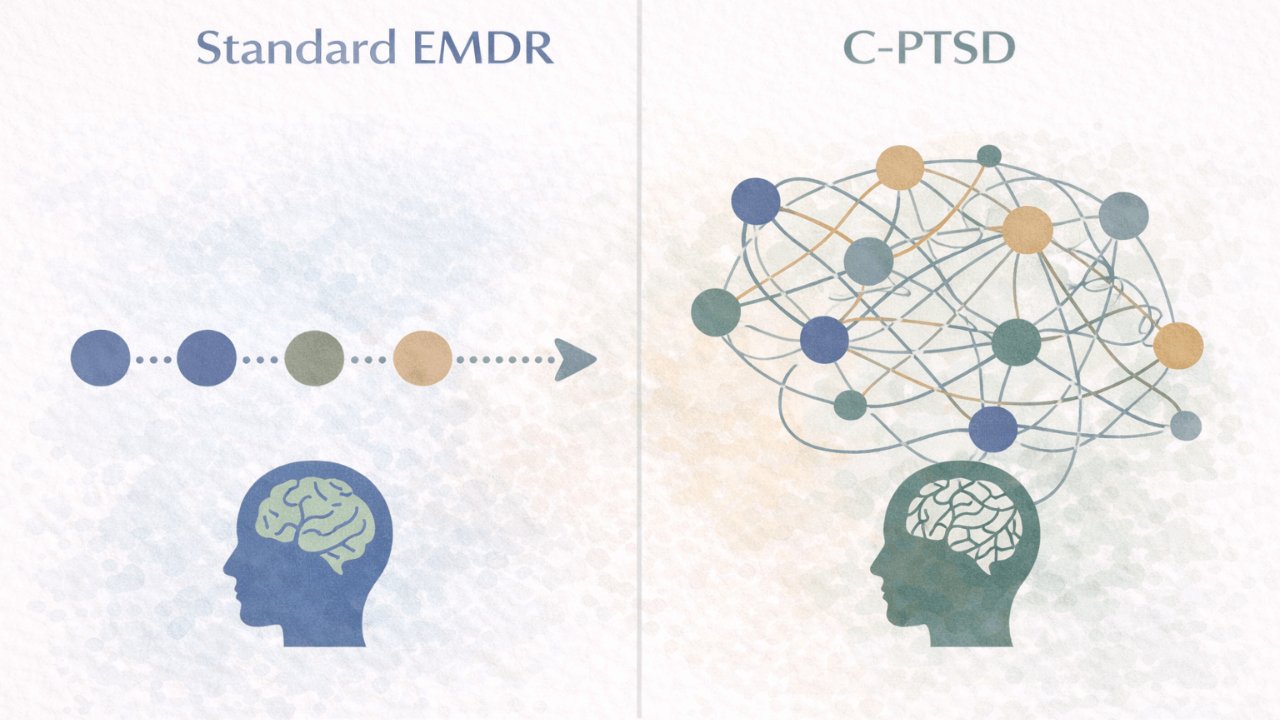
Complex PTSD develops differently than single-incident trauma. Instead of one overwhelming event that the nervous system couldn't process, C-PTSD emerges from chronic, repeated trauma, often in relationships where the person should have been safe. Childhood abuse. Neglect. Growing up with a caregiver who was both the source of comfort and the source of terror.
The result? Survival adaptations that run deep. We're talking about nervous systems that learned to stay on high alert or shut down entirely just to make it through the day. Attachment patterns that wire in the belief that connection equals danger. And often, a fragmented sense of self where different "parts" hold different pieces of the trauma story.
When you try to run standard EMDR on these clients, a few things tend to happen:
They stay activated across all eight phases. That fight-or-flight response doesn't dial down just because you've installed a resource. Their nervous system has been running hot for years, sometimes decades. A calm place visualization isn't going to override that kind of wiring.
They disappear mid-session. Not literally, of course. But you'll notice that glazed look, that distant stare. Dissociation kicks in as a protective mechanism, and suddenly the person sitting across from you isn't really there anymore.
Dual awareness becomes impossible. Standard EMDR relies on the client being able to hold one foot in the trauma memory and one foot in the present moment. But for someone with C-PTSD, the trauma isn't a discrete memory. It's woven into their sense of self, their relationships, their entire worldview. There is no "then versus now" because the trauma is still happening, at least to their nervous system.
Processing loops endlessly. You work on a target. It shifts a little. Then it circles back. Or a new memory pops up. Or a part takes over and suddenly you're working with an entirely different presentation. The neat, linear progress you were promised in training? Not happening here.
Is standard EMDR enough for clients with C-PTSD, or do I need advanced training? Honestly, if you're regularly working with developmental trauma, attachment injuries, or high dissociation, basic EMDR training will only take you so far. These clients need adaptations that go beyond the standard eight-phase protocol.
How C-PTSD Actually Shows Up in Your EMDR Sessions
Let me paint you a picture you've probably already lived.
Your client comes in for what should be a straightforward reprocessing session. You've done the prep work. You've got a target. You start bilateral stimulation. And within two sets, one of three things happens:
Option A: Total activation. Their heart rate spikes. They're talking faster. Their body is rigid. You try to bring them back to the present, but they're already flooded. The window of tolerance you thought you'd established? Gone.
Option B: Complete shutdown. They go quiet. Their face goes blank. When you ask what they're noticing, they say "nothing" or "I don't know." They've left the building, neurologically speaking, and you're now sitting with a defended, dissociated system that has zero interest in processing anything.
Option C: Parts show up uninvited. Mid-session, your client's voice changes. Or they start talking about themselves in third person. Or a younger, terrified version of them is suddenly running the show, and the adult you were just talking to is nowhere to be found.
These aren't signs that you're doing something wrong. They're signs that you're working with structural dissociation, chronic dysregulation, and a nervous system that has learned to protect itself in ways that standard EMDR wasn't designed to address.
Your job isn't to force the protocol. Your job is to meet the client's nervous system where it actually is.

Principle #1: Start With the Nervous System, Not the Protocol
Here's the truth that nobody tells you in basic EMDR training: You cannot process trauma if the nervous system isn't regulated enough to tolerate it.
This is where Polyvagal-informed EMDR becomes essential. Before you even think about targeting a memory, you need to assess where your client's autonomic nervous system is living most of the time. Are they stuck in sympathetic overdrive (fight/flight)? Chronic dorsal vagal shutdown (freeze/collapse)? Ping-ponging between the two?
Standard EMDR assumes a baseline level of nervous system flexibility that many C-PTSD clients simply don't have. They're not being difficult or resistant. Their bodies literally cannot access the ventral vagal state (safe and social) long enough to do the work.
So instead of jumping straight into Phase 3, you stay in Phase 2 longer. Much longer. You use somatic resourcing to help them find even brief moments of regulation. You teach them to notice their internal state without judgment. You build what Polyvagal theory calls "neuroception of safety," the subconscious sense that it's safe enough to let the guard down.
Practical moves that actually help:
Map their nervous system states. Use language your client understands. "When you go into that numb, foggy place, that's your system hitting the brakes. When your heart races and you can't sit still, that's your system getting ready to fight or run." Name it so they can start to recognize it.
Build micro-moments of regulation. You're not trying to get them to a consistent, stable calm. That's not realistic. You're aiming for them to touch down into regulation for even 30 seconds at a time. That's the window you work within.
Use bilateral stimulation for regulation, not just reprocessing. Slow, rhythmic tapping or eye movements can help bring an activated system down or a shut-down system back online. This is EMDR as a nervous system tool, not a memory processing tool.
Anchor resources in the body. Abstract visualizations often don't stick with C-PTSD clients. But if they can feel their feet on the ground, notice their breath, or sense the support of the chair beneath them, you're giving their nervous system something real to orient to.
This isn't a detour from EMDR. This is the foundation that makes EMDR actually possible.
Principle #2: Use a Preparation Hierarchy for Treatment Planning
One of the biggest mistakes therapists make with C-PTSD clients is trying to apply a symptom-driven or protocol-driven treatment plan when what's actually needed is a capacity-driven approach.
What does that mean in practice? It means you're not asking "What trauma should we target next?" You're asking "What can this client's nervous system actually handle right now?"
Enter the Preparation Hierarchy, a framework that aligns your interventions with your client's functional capacity at any given moment. Think of it as a roadmap that meets clients where they are, not where the protocol says they should be.
Here's what that hierarchy looks like in simplified form:
Level 1: Safety and basic regulation. The client can identify when they're dysregulated and use at least one grounding technique that actually works for them. They have some sense of safety in the therapy relationship. Suicidal ideation, if present, is managed. Self-harm is not active.
Level 2: Dual awareness and body awareness. The client can maintain some connection to the present while touching difficult material. They can notice sensations in their body without immediately dissociating or becoming overwhelmed. They understand the difference between "then" and "now," at least conceptually.
Level 3: Limited, constricted processing. The client can handle small doses of trauma material without completely decompensating. You're using modified EMDR approaches like EMD (eye movement desensitization without full reprocessing) or working on circumscribed targets like intrusive images or nightmares rather than full memory networks.
Level 4: Full protocol on carefully selected targets. The client has enough nervous system flexibility and dual awareness to engage in standard reprocessing. Even here, you're being strategic about which memories to target and when.
Most C-PTSD clients will need to spend significant time in Levels 1 and 2. That's not a failure. That's appropriate, trauma-informed care.
How do I know when a C-PTSD client is actually ready for reprocessing? Watch for three things: Can they regulate enough to stay present? Can they hold dual awareness for at least brief periods? And do they have enough trust in you and the process to signal when they need to stop? If the answer to any of those is "not yet," you're still building capacity, not processing trauma.
Principle #3: Work With Dissociation and Parts, Not Around Them
Let's talk about what happens when you're mid-session and suddenly the person across from you isn't the same person you started with.
Their voice might change. Their posture shifts. They refer to themselves in third person or talk about "her" or "them" when they mean themselves. Or they go completely blank, unreachable, like someone flipped a switch.
This is structural dissociation, and if you trained in standard EMDR, you probably got about fifteen minutes of coverage on it, if that. You were told to "watch for dissociation" and maybe "bring the client back to the present," but nobody really prepared you for what to do when different parts of your client's self hold different pieces of the trauma, different emotions, and different levels of readiness to heal.
Here's what you need to know: Dissociation isn't a problem to fix. It's a survival adaptation that helped your client get through something unbearable. And when parts show up during EMDR, they're usually showing up for a reason.
Maybe there's a protective part that doesn't trust this whole therapy thing and is trying to shut it down. Maybe there's a young part holding the most overwhelming piece of the trauma, and it doesn't feel safe enough to let that material come forward. Maybe there's a part that's terrified of what will happen if the trauma actually gets processed, if the client actually gets better.
What should I do if a client dissociates or a part "takes over" during EMDR? First, stop the bilateral stimulation. Then, orient to what's happening. Ask the part what it needs or what it's worried about. You're not trying to push through or override it. You're acknowledging that this part has valuable information and deserves to be heard. Often, that acknowledgment alone is enough for the system to settle.
Practical strategies that work:
Screen for dissociation before you start reprocessing. Use simple tools like the DES (Dissociative Experiences Scale) or just ask directly: "Do you ever feel like there are different parts of you? Do you lose time or have gaps in your memory?" If the answer is yes, you need to do parts work before, or alongside, traditional EMDR.
Learn basic Ego States interventions. You don't need to be an IFS therapist or a full Ego State specialist. But knowing how to establish internal communication, negotiate with protective parts, and create safety agreements between parts can make or break your EMDR work with complex trauma clients. TTI's Ego States Integration course offers this kind of practical, immediately applicable training.
Know when to pause and return to Phase 2. If a part emerges mid-session and you can't establish safety or cooperation, that's not the time to push forward. Go back to resourcing. Strengthen the relationship between parts. Build internal trust. That's not a step backward. That's the work.
Use parts language even if your client doesn't. You can say things like, "It seems like one part of you wants to work on this memory, but another part is really scared. Is that what's happening?" This normalizes the experience and gives your client permission to acknowledge what they're feeling without needing a diagnosis or a theoretical framework.
EMDR doesn't have to be an either/or with parts work. In fact, for C-PTSD clients, integrating both approaches often produces the most sustainable results.

Principle #4: Constricted Processing for Intrusive, Highly Charged Targets
Standard EMDR asks you to open up the entire memory network and let it process wherever it wants to go. And for single-incident trauma, that works beautifully. The memory shifts, the distress drops, new insights emerge, and you close the session with a client who feels lighter.
But with C-PTSD, opening up the whole network can be destabilizing, even dangerous. These clients don't have one discrete trauma memory. They have hundreds. And those memories are all connected through deeply embedded core beliefs, attachment injuries, and survival patterns that have been running for years.
So instead of full reprocessing, you use constricted processing. This approach, sometimes called EMD (eye movement desensitization) or EMDr (EMDR with limited reprocessing), targets specific symptoms or narrow slices of memory without activating the entire trauma network.
Think of it like this: instead of opening all the windows and doors in a house during a storm, you crack one window just enough to let some pressure out, then close it again before things get chaotic.
When to use constricted processing:
For intrusive symptoms. Nightmares. Flashbacks. Intrusive images that won't leave your client alone. You target the specific symptom, desensitize it enough that it loses its charge, and stop there. You're not chasing associations or looking for insights. You're reducing the immediate distress.
For highly charged but circumscribed memories. Maybe there's one specific moment within a larger pattern of abuse that's particularly haunting. You work on that moment in isolation, using fractionated processing to avoid pulling in all the connected material.
When the client is between Levels 2 and 3 on the Preparation Hierarchy. They have some capacity for trauma work, but not enough to handle full reprocessing safely. Constricted processing gives them the experience of relief without overwhelming their system.
Francine Shapiro, the creator of EMDR, actually developed early versions of this approach for use with highly distressed clients. It's not a workaround. It's an intentional, clinically sound adaptation.
In practice, this looks like:
Shorter sets of bilateral stimulation. Maybe 6 to 12 passes instead of the usual 24 or more.
Stopping when distress drops, not when insights emerge. You're tracking the SUD (Subjective Units of Disturbance), and as soon as it drops to a tolerable level, you stop. You don't keep going to see what else comes up.
Avoiding open-ended prompts like "What do you notice now?" Instead, you guide: "Notice the image. How disturbing is it now?" You keep the focus tight and contained.
Debriefing carefully at the end. You're checking that the client is back to baseline before they leave your office. Grounding. Orienting to the present. Reinforcing their capacity to regulate.
This isn't a compromise. This is meeting the complexity of C-PTSD with the nuanced, flexible approach it demands.
Principle #5: Rethinking "Progress" With C-PTSD
If you're waiting for those clean, linear SUD drops you saw in your EMDR training videos, you're going to be waiting a long time with C-PTSD clients.
Progress with complex trauma doesn't look like progress with single-incident PTSD. The markers are different. The timeline is longer. And if you're measuring success by whether a memory goes from a SUD of 8 to a SUD of 0 in one session, you're going to burn out fast.
Here's what progress actually looks like:
Increased window of tolerance. Your client used to get triggered and stay dysregulated for days. Now it's hours. They can come back to baseline faster. That's huge.
More stable dual awareness. They can talk about the trauma without completely losing themselves in it. They can hold "that was then, this is now" for longer stretches. Even if it's still hard.
Reduced intrusions. The nightmares aren't gone, but they're less frequent. The flashbacks still happen, but they're shorter and less intense.
Improved daily functioning. They're sleeping better. Showing up to work more consistently. Managing relationships with a little more ease. These real-world improvements matter more than any number on a SUD scale.
Better relationship with themselves. The harsh self-criticism softens. The shame doesn't hit as hard. They start to see themselves as a person who survived, not a person who's broken.
This shift in expectations matters because it protects you from clinician burnout and it protects your client from feeling like they're failing at therapy. C-PTSD is not a quick fix. It's deep, slow, sometimes frustrating work. And that's okay.
You're not aiming for a single moment of cathartic processing. You're building a foundation of safety, regulation, and self-compassion that allows your client to integrate their trauma over time, in doses they can actually handle.
That's not settling. That's honoring the reality of what complex trauma does to a human nervous system.
What This Looks Like in Real Sessions
Let me give you a few snapshots of what adaptive EMDR with C-PTSD clients actually looks like in the room.
Scenario 1: The highly dysregulated client
Sarah comes in for what should be a reprocessing session. You've been working together for months. But today she's wired. She's talking fast, her leg is bouncing, and when you try to start bilateral stimulation, her distress spikes immediately.
You stop. You don't push through. Instead, you say, "I'm noticing your system is pretty activated right now. Let's take care of that first before we do any processing." You shift to slow, rhythmic tapping to help bring her nervous system down. You guide her through a grounding exercise. You ask what's happening in her life that might be contributing to this activation.
Twenty minutes later, she's more settled. But you make the call: today isn't the day for reprocessing. Instead, you strengthen her capacity to recognize and respond to her own activation. You're building the foundation that makes future processing possible. And you end the session with her feeling competent and cared for, not like she failed at therapy.
Scenario 2: The client with strong parts
Miguel is in the middle of a reprocessing set when his whole demeanor changes. His voice gets smaller. He starts talking about himself in third person. A protective part has stepped in, and it's clear this part doesn't want the processing to continue.
You pause the bilateral stimulation. You speak directly to the part: "I can tell someone is here who's concerned about what we're doing. Can you tell me what you're worried about?"
The part says it's scared that if Miguel processes this memory, he'll fall apart. He won't be able to function. You acknowledge that fear. You ask the part what it needs in order to feel safe. Together, you negotiate a slower pace. You establish an agreement that if the processing gets too intense, this part can signal and you'll stop.
This isn't a detour. This is the work. And by honoring the part's concerns, you're actually building the internal cooperation that will make deeper processing possible down the line.
Scenario 3: Using constricted processing
Keisha has been having the same nightmare for weeks. It's affecting her sleep, her mood, everything. But when you assess her capacity, it's clear she's not ready for full reprocessing of the trauma memories connected to that nightmare.
So you use EMD. You target just the nightmare itself. Short sets of bilateral stimulation, focused only on desensitizing that specific image and the distress it brings. You're not opening up associations. You're not chasing insights.
After three sets, the charge on the nightmare drops. Keisha reports feeling like she can breathe again. The nightmare might come back, and if it does, you'll repeat this process. But right now, she has relief. And that relief is building her trust in EMDR and in her own capacity to handle difficult material.
These aren't perfect, textbook sessions. They're real, messy, adaptive responses to what complex trauma actually demands.
When You Need More Support
Here's the thing about working with C-PTSD and EMDR: you can't do this work in a vacuum.
If you're regularly treating clients with developmental trauma, high dissociation, or chronic dysregulation, you need support structures beyond your basic EMDR training. That might mean:
Consultation specifically for complex trauma cases. General EMDR consultation is helpful, but you need someone who really understands the nuances of C-PTSD, structural dissociation, and nervous system regulation. Someone who can help you troubleshoot when you're stuck and normalize the slow, nonlinear nature of this work.
Advanced training in EMDR for complex PTSD. Courses that go deeper into phase-oriented approaches, parts work, Polyvagal-informed interventions, and the specific adaptations that make EMDR safe and effective for this population.
Training in complementary modalities. Ego States work. Somatic interventions. Polyvagal-informed therapy. These aren't extras. They're essential tools for the kind of complexity you're facing.
The clinicians who do this work well aren't the ones who white-knuckle their way through difficult cases alone. They're the ones who invest in ongoing learning, who seek out consultation when they're stuck, and who recognize that treating complex trauma requires a level of sophistication that basic EMDR training simply doesn't provide.
You're not failing if you need more training. You're being responsible.
A Note for Social Workers This March
March is Social Work Appreciation Month, and if you're a social worker who's been carrying the weight of complex cases without enough support, this is for you.
Social workers are disproportionately likely to work with the clients who need this kind of adaptive, trauma-informed EMDR. You're in the trenches with developmental trauma, chronic poverty, systemic oppression, and the kind of relational wounds that don't fit neatly into a standard treatment protocol. And often, you're doing this work with fewer resources, less institutional support, and more administrative burden than your colleagues in other disciplines.
Through March 18-22, TTI is offering a limited-time reduced rate on EMDR and Complex PTSD training as a way of recognizing the vital work social workers do. If you've been wanting deeper training in how to adapt EMDR for your most complex clients, this is your window.
The course runs live on May 14-15, 2026 via Zoom with trainer Erica Bonham, LPC, a certified EMDR clinician, consultant, and expert in somatic and attachment-based EMDR. Erica brings a blend of clinical rigor and irreverent warmth to her teaching, and she specializes in exactly the kind of cases that keep you up at night: clients with parts, high dissociation, and nervous systems that don't respond to standard approaches.
You deserve training that actually prepares you for the work you're already doing.
You Already Know More Than You Think
If you've been working with C-PTSD clients and feeling like you're flying by the seat of your pants, I want you to hear this: your instincts are probably right.
When you slow down the protocol because your client needs it, you're doing the right thing. When you spend extra time in Phase 2 building resources and regulation, you're not wasting time. You're building a foundation. When you stop mid-session because a part shows up or because your client dissociates, you're practicing good, attuned, trauma-informed care.
The problem isn't you. The problem is that basic EMDR training sets expectations based on single-incident trauma, and then clinicians get into the field and realize that a huge percentage of their clients don't fit that model.
Complex PTSD demands more from you. It demands deeper understanding of the nervous system. It demands flexibility with the protocol. It demands that you see parts not as obstacles but as protective adaptations. It demands patience with progress that doesn't look like what you were taught to expect.
But here's what you get in return: You get to do some of the most meaningful, transformative work a therapist can do. You get to witness people who've been surviving finally start living. You get to be the person who doesn't give up on them when their trauma feels too big or too messy.
And with the right training, consultation, and support, you can do this work sustainably, without burning out or second-guessing yourself every step of the way.
The Hidden Variable in Complex PTSD: How Shame Complicates Everything
There is one more layer that does not always get named in conversations about complex PTSD, even though it shows up in almost every session: shame.
Not the acute shame of a single embarrassing memory. The deeper kind that has been installed over years of relational trauma, systemic harm, or ego-dystonic behavior that happened during states of overwhelming emotion. The kind that sits quietly under the surface and pulls the rug out from under your processing every time you get close to something real.
Shame operates differently from fear or grief in EMDR. With fear, you can track the activation. With shame, you often can't, because one of shame's most reliable functions is to make itself invisible. It shows up as deflection, as sudden compliance, as the client who goes flat in Phase 4 and reports "nothing" while their body language tells you something very different. It shows up as the negative cognition that stays stuck at a VOC of 3 no matter what you install. It shows up as blocked processing that looks like resistance but is actually a protective system doing exactly what it learned to do.
Shame also has a relationship with anger and depression that matters enormously for complex PTSD work. Anger, shame, and depression in trauma clients are not three separate clinical problems. They move together on a continuum. Anger often functions as a protective response to unmet needs or boundary violations. When that anger generates behavior that the client later judges as ego-dystonic, shame arrives as a critic. And shame's weight, particularly when it is chronic and layered, often collapses into depression. The cycle reinforces itself, and the memory network underneath it all stays unprocessed.
In AIP terms, shame frequently functions as a feeder network that keeps both anger and depression active. It is rarely the target the client names first, and it can quietly block every target they do name.
What this means for your EMDR work with complex PTSD clients:
In Phase 2, generic resourcing often fails when shame is present. A nurturing figure or safe place that hasn't been specifically prepared to hold the part that carries shame may not provide the stability you're expecting during reprocessing. The more shame is present in the system, the more dissociation you are likely to see, and the more each part needs to be resourced before you proceed.
In Phase 3, the negative cognition with shame-based presentations tends to be more self-referencing and more globally held than in straightforward single-incident trauma. Expect NCs in the "I am fundamentally bad / defective / unlovable" cluster. The client may also minimize or qualify them, which is itself a shame response.
In Phase 4, watch for processing that loops back to self-criticism rather than moving through the memory network. This is a signature of shame interference. Interweaves that name the shame directly, without amplifying it, can help restore movement: "What would you say to someone else who had done that, or had that done to them?" The relational repair that comes through the therapeutic relationship during this phase is not incidental. It is part of what makes the reprocessing work.
In Phase 5, the positive cognition may not install if shame is still active beneath a SUDS of 0. A VOC that stays low despite apparent desensitization is worth investigating rather than pushing past. Sometimes the system is not ready to hold the new belief because a shamed part has not yet been reached.
In Phase 6, somatic expressions of anger during the body scan are a sign of progress, not a problem. As clients move back through the continuum from depression toward anger, you may see physical activation that looks like it's going the wrong direction. It isn't. The goal is movement, not stillness.
If you are doing EMDR with complex PTSD clients and shame is a consistent presence in the room, understanding the full anger-shame-depression framework gives you something that isolated protocol adaptations don't: a clinical map that tells you where the client is, where they're headed, and what the system needs at each point in the journey.
____________________________________________________________________________________
Want a phase-by-phase framework for working with anger, shame, and depression in EMDR? Joel Kouame, LCSW, MBA, CAMS covers exactly this in EMDR for Anger, Shame, and Depression: Neuroscience-Informed Training for Trauma Therapists, a TTI Advanced EMDR Training on July 17.
____________________________________________________________________________________
Ready to Go Deeper?
If you're ready to move beyond basic EMDR protocol and learn how to truly adapt your approach for clients with complex PTSD, EMDR and Complex PTSD is where you start.
This isn't a beginner course. It's designed for EMDR-trained clinicians who are already working with developmental trauma, dissociation, and chronic dysregulation and need the advanced tools to do it well.
You'll learn:
- How to use a Polyvagal-informed lens to assess nervous system capacity before reprocessing
- The Preparation Hierarchy and how to align your interventions with your client's actual readiness
- Practical strategies for working with parts and structural dissociation within EMDR sessions
- When and how to use constricted processing to reduce overwhelm
- How to recognize real progress in C-PTSD treatment beyond SUD scores
The course runs live on May 14-15, 2026 via Zoom with Erica Bonham, LPC, a certified EMDR clinician, consultant, and trainer who specializes in serving clients with complex trauma, attachment injuries, and dissociation.

About Your Trainer, Erica Bonham, LPC
Erica Bonham is a certified EMDR clinician, consultant, and trainer, and a licensed professional counselor in Colorado. She specializes in serving the LGBTQ+ community, abuse recovery, and trauma related to social injustice and spiritual abuse, with a focus on somatic and attachment-based EMDR and ego state work.
A seasoned educator, Erica has led EMDR and trauma therapist trainings across the country, including for Montgomery County School District (Baltimore, MD), Athens-Clarke County School District (GA), and the Domestic Violence Coalition in Denver, CO. She weaves her background as a yoga instructor and mindfulness practitioner into her EMDR teaching, helping clinicians deepen their clients' connection to their bodies and nervous systems.
Erica is the creator of the courses Cultivate Your Inner Badass and Healthy Hope: EMDR Best Practices for Healing Spiritual Trauma, and co-creator (with Dr. Chinwé Williams) of Healing Racial Trauma with Somatic Therapy. She brings a blend of rigor, irreverence, and heart to everything she teaches, aspiring to be a catalyst for change, justice, and growth while dismantling systems of oppression.
If you're tired of feeling underprepared for your most complex clients, this is how you change that.
Learn more and register for EMDR and Complex PTSD
Additional Resources
- Polyvagal Theory for EMDR Therapists
- Ego States Integration for the EMDR Therapist
- EMDR Target Sequence Plans Made Easy
- Be With Parts Who Block EMDR Work - Free Worksheet
- TTI Programs for Social Workers
References
- De Jongh, A., Resick, P. A., Zoellner, L. A., van Minnen, A., Lee, C. W., Monson, C. M., Foa, E. B., Wheeler, K., Broeke, E. T., Feeny, N., Rauch, S. A. M., Chard, K. M., Mueser, K. T., Sloan, D. M., van der Gaag, M., Rothbaum, B. O., Neuner, F., de Roos, C., Hehemann, L. E., ... Bicanic, I. A. E. (2016). Critical analysis of the current treatment guidelines for complex PTSD in adults. Depression and Anxiety, 33(5), 359-369. https://doi.org/10.1002/da.22469
- Edmond, T., Rubin, A., & Wambach, K. G. (2011). The effectiveness of EMDR with adult female survivors of childhood sexual abuse. Social Work Research, 35(2), 103-116. https://doi.org/10.1093/swr/35.2.103
- EMDR International Association. (n.d.). EMDR research overview. https://www.emdr.com/research-overview/
- Forgash, C., & Copeley, M. (Eds.). (2008). Healing the heart of trauma and dissociation with EMDR and ego state therapy. Springer Publishing Company.
- Korn, D. L., & Leeds, A. M. (2002). Preliminary evidence of efficacy for EMDR resource development and installation in the stabilization phase of treatment of complex posttraumatic stress disorder. Journal of Clinical Psychology, 58(12), 1465-1487. https://doi.org/10.1002/jclp.10099
- Malandrone, F., Carletto, S., Hase, M., Hofmann, A., & Ostacoli, L. (2019). A brief narrative summary of randomized controlled trials investigating EMDR treatment of patients with depression. Journal of EMDR Practice and Research, 13(4), 302-306. https://doi.org/10.1891/1933-3196.13.4.302
- Shapiro, E. (2009). EMDR treatment of recent trauma. https://emdr-belgium.be/wp-content/uploads/2017/12/EMDR-Treatment-of-Recent-Trauma.-Elan-Shapiro-2009.pdf
- Shapiro, F. (2018). Eye movement desensitization and reprocessing (EMDR) therapy: Basic principles, protocols, and procedures (3rd ed.). Guilford Press.
- Van der Hart, O., Nijenhuis, E. R. S., & Steele, K. (2006). The haunted self: Structural dissociation and the treatment of chronic traumatization. W. W. Norton & Company.
- Zepeda Méndez, M., Nijdam, M. J., Ter Heide, F. J. J., van der Aa, N., & Olff, M. (2018). A five-day inpatient EMDR treatment programme for PTSD: Pilot study. European Journal of Psychotraumatology, 9(1), Article 1425575. https://doi.org/10.1080/20008198.2018.1425575
Stay connected with fun info, news, promotions and updates!
Join our mailing list to receive the latest news and updates from our team.
Don't worry, your information will not be shared.