
trauma
neuroscience
clinical foundations

Stay in the loop
Trauma-informed tools, new trainings, and the occasional pep talk. No spam, ever.


Read time: 11 minutes
A trauma therapist sits down to write her case note after a difficult session. The processing felt productive in the moment. The client moved through what seemed like a meaningful piece of memory, the SUD came down, and the body cues looked like resolution. And yet, as the therapist writes, she notices a familiar feeling she has been having more often lately. The case is moving, but it is not moving forward. Last week's session looked like progress. This week looks like a return to the same material. The week before that, the same. The processing keeps doubling back.
She is not under-trained. She is not avoiding the work. She is sitting with a clinical phenomenon that her training did not name, and that she has been quietly carrying through several cases now. Something is interfering with the trauma work. She is starting to suspect she knows what.
OCD interferes with trauma treatment in ways most clinicians were not taught to see. The interference is rarely dramatic. It does not look like a crisis. It looks like processing that does not stick, sessions that revisit the same content with different language, and a slow accumulation of clinical exhaustion in cases that should, by now, be moving.
This piece is about how to recognize that interference, what its mechanisms are, and what to do when you suspect it is happening.
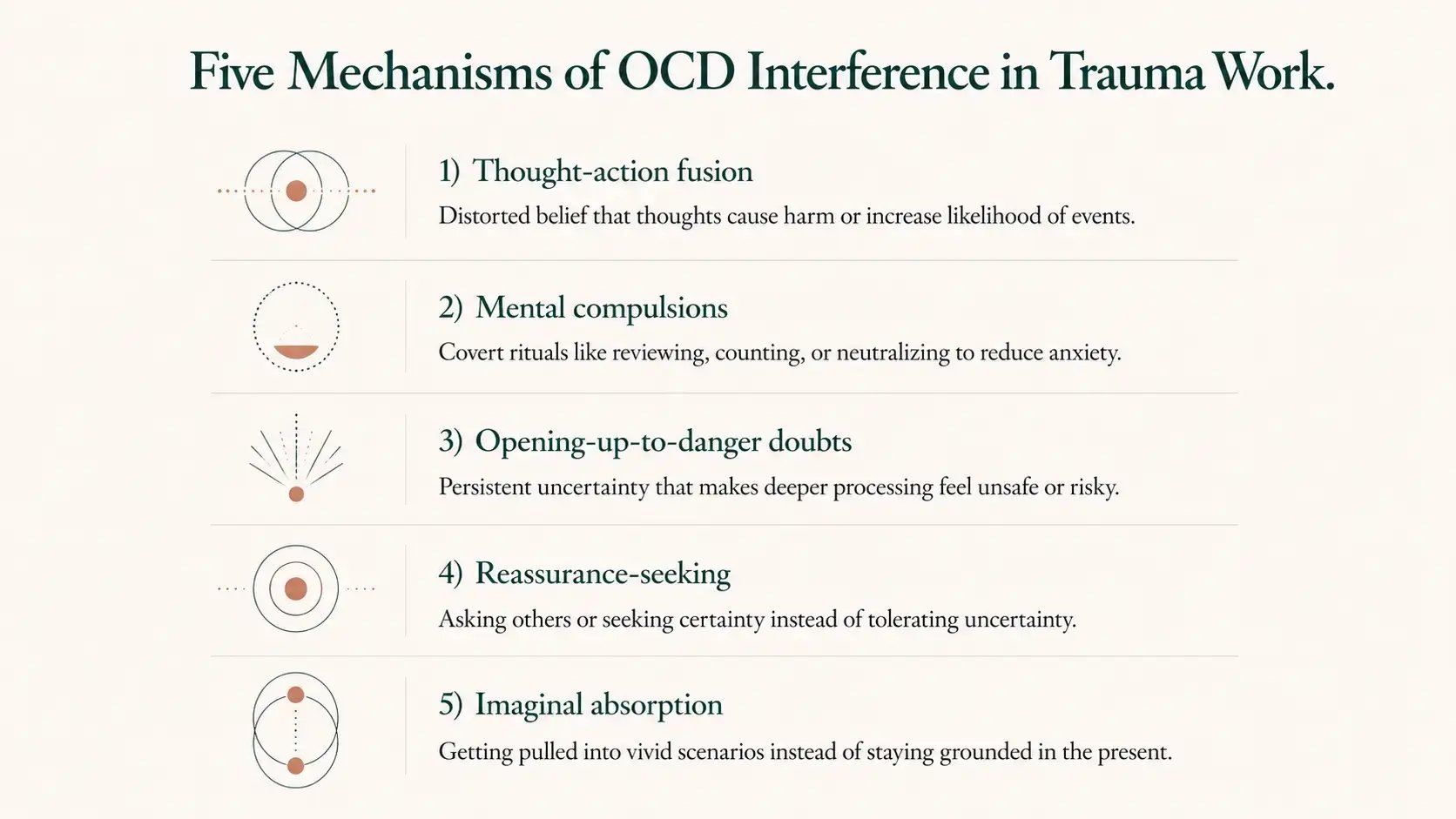
OCD interferes with trauma processing through several specific cognitive and behavioral mechanisms. Each one operates quietly, often inside what looks like normal clinical engagement, and each one can derail trauma work without any obvious signal that something is wrong.
Thought-action fusion is the first mechanism. A client whose obsessional system links having a thought with performing the corresponding action will struggle in any treatment that asks them to attend to internal experience. Trauma processing, by definition, asks the client to attend to internal experience. The client with thought-action fusion experiences the act of bringing up the trauma content as itself a kind of moral or causal danger. The result is a client who appears to engage, who follows the protocol, who reports SUD changes, and who returns the next session with the same material, sometimes with new layers of obsessional elaboration around it.
Mental compulsions are the second mechanism, and the most clinically invisible. Williams and colleagues (2011) documented how mental compulsions, including mental review, undoing, mental neutralizing, counting, and prayer, are among the most underrecognized features of OCD in clinical settings, and how they routinely escape detection in assessment. In trauma treatment, mental compulsions are often performed in real time during processing. The client may be silently reviewing whether they remembered the event correctly, silently undoing a feared thought, or silently counting to neutralize an image. The clinician sees a client who is processing. What is actually happening is a parallel obsessional process running underneath the trauma work, and it is the obsessional process that is shaping what the client reports.
Opening-up-to-danger doubts are the third mechanism. A client whose obsessional system generates new doubts in response to any form of certainty will experience trauma processing as a generator of fresh material to obsess about. Each session opens a new possibility the obsessional system can take up. "What if I missed something important about what happened?" "What if the new memory means something I have not figured out yet?" "What if I am misremembering and the real memory is worse?" The therapist is doing trauma work. The OCD system is doing its job: producing doubt about whatever the client gets close to.
Reassurance-seeking is the fourth mechanism, and the one most likely to involve the therapist directly. A client with OCD often asks the same question across sessions, in slightly different forms, and the answer does not seem to settle anything. The therapist, trying to be helpful, answers each version. The client receives the answer, feels brief relief, and asks the question again the next session. The reassurance-seeking is functioning as a mental compulsion, and the therapist has become part of the compulsion. Trauma processing in this context becomes another generator of new questions to seek reassurance about.
And imaginal absorption is the fifth mechanism. Certain OCD sub-types, particularly real-event OCD and false-memory OCD, produce mental imagery vivid enough to mimic memory. A client with imaginal absorption may describe a flashback that is, on closer examination, an obsessional elaboration of a fragment of memory into a fully constructed scene. The trauma therapist who treats the elaboration as a flashback may be reinforcing the obsessional process rather than processing the original memory.
EMDR is one of the trauma modalities most vulnerable to OCD interference, partly because the protocol asks the client to hold a target in mind while attending to internal experience and reporting changes. We have written elsewhere about when EMDR gets stuck and the somatic lens for working with clients who go numb, flood, or seem to vanish during processing. OCD interference is an underrecognized cause of those same clinical phenomena.
The most common signal in EMDR is processing that loops. The target comes up, processes for a set, and returns to the same content. The next set produces the same return. The client reports a SUD that does not move, or that moves down briefly and rebounds. The clinician, trained to address blocked processing through cognitive interweaves, somatic resourcing, or target refinement, tries each in turn. None of them resolves the loop. The processing keeps doubling back.
What is often happening is that the client is engaging in mental compulsions between sets. They are silently reviewing the memory, silently checking whether their report is accurate, silently neutralizing a feared interpretation. Each set delivers new content, and the compulsive process processes it back into the same shape. The bilateral stimulation is doing what it does. The obsessional system is also doing what it does. The interference is bilateral.
A second EMDR signal is processing that produces new obsessional content rather than resolution. The client reports a new doubt that emerged during the set. "What if I am making this up?" "What if the real memory is different from what I just described?" "What if processing this means I am minimizing what happened?" Each new doubt is a fresh target for the obsessional system. The therapist who treats each doubt as new clinical material to process is being drawn into the obsessional loop rather than resolving the original memory.
A third signal is dissociative-appearing presentation during processing that does not resolve with standard dissociation interventions. The client appears to go blank or check out, but resourcing, grounding, and titration do not fully bring them back into the work. What may be happening is intense internal mental activity (compulsive review, neutralizing, undoing) that looks externally like dissociation but is actually high-effort cognitive activity.
And a fourth signal is between-session regression that does not fit the case. The client leaves a productive-feeling session and returns the next week worse, with heightened symptoms, increased reassurance-seeking, and new content the therapist has not seen before. Pinciotti (2023) noted that exposure work in dynamic OCD-PTSD comorbidity can trigger compulsive elaboration between sessions, and the same risk applies to EMDR processing that touches obsessional content without recognizing it.

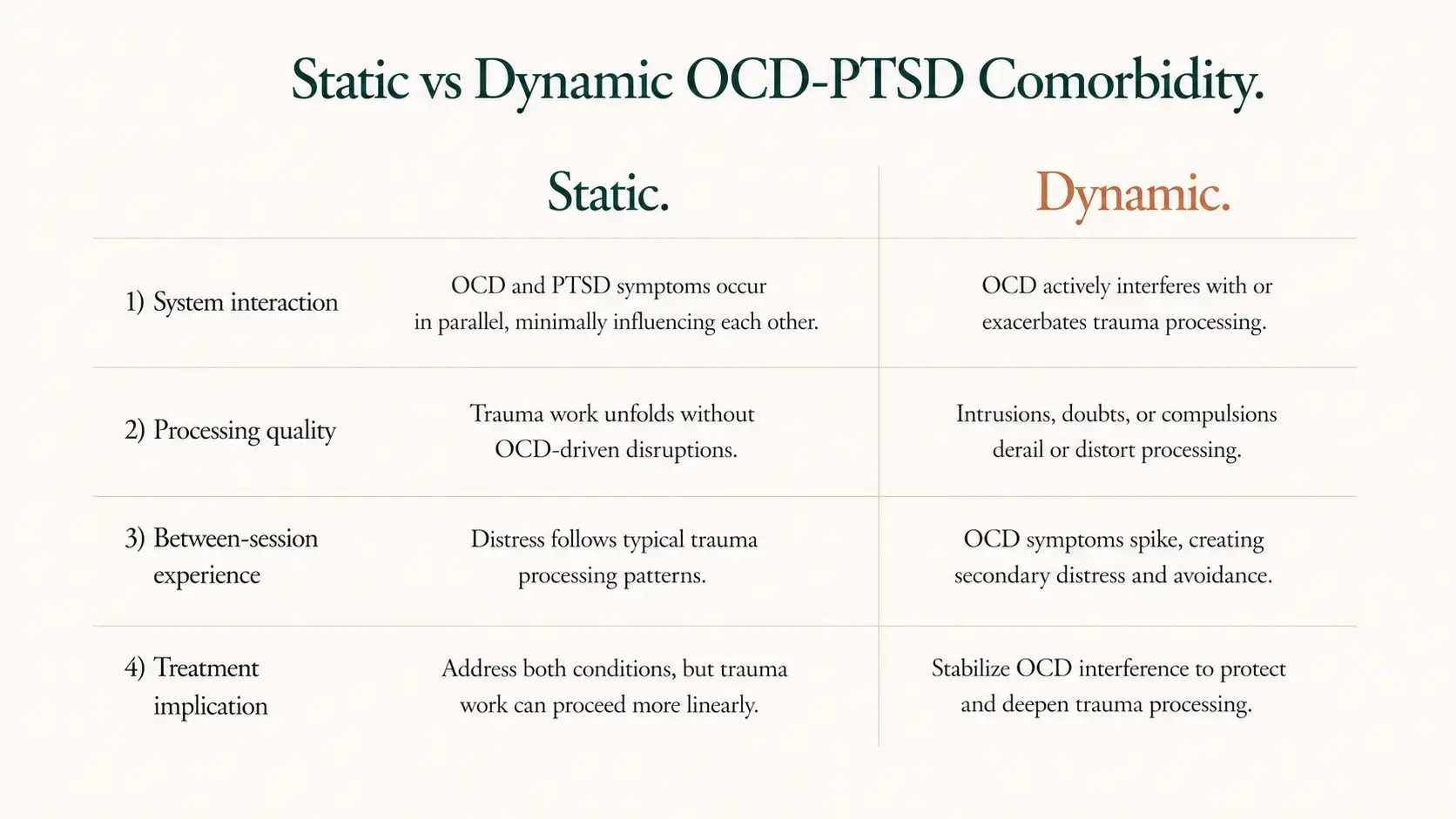
The distinction between static and dynamic OCD-PTSD comorbidity matters for whether trauma work is workable in its current form.
In static comorbidity, OCD and PTSD coexist but operate relatively independently. The client has identifiable OCD symptoms in some life domains and identifiable PTSD symptoms in others, and the two systems do not interlock. Trauma processing can usually proceed, with attention to the OCD symptoms running in parallel. Sequencing matters here. Stabilizing the OCD enough that mental compulsions are not actively running during processing makes the trauma work more workable.
In dynamic comorbidity, the two systems interlock. The OCD content is about the trauma. The trauma intrusions become targets for compulsive review. The compulsions interrupt processing. Trauma work that does not address the OCD interference tends to stall, regress, or actively worsen the obsessional system. This is the picture that most often produces the looping, doubling-back quality of processing that does not stick.
A working test for which picture is in front of you: ask the client what they think about the memory between sessions. A client with static comorbidity will describe memory work that integrates over the week. A client with dynamic comorbidity will describe extensive mental review of the memory, checking whether their report was accurate, looking for new details, trying to figure out whether the real memory is different. The first describes processing. The second describes compulsion.
The first move is to slow the trauma work. This does not mean abandoning the trauma case. It means pausing aggressive trauma processing while the OCD picture is assessed. Continuing trauma work in the face of probable OCD interference often produces the kind of regression that loses clinical ground.
The second move is structured assessment. The Yale-Brown Obsessive Compulsive Scale (Y-BOCS-II) is the standard measure for OCD severity and is freely available for clinical use. The Y-BOCS surfaces mental compulsions and reassurance-seeking patterns the client may not have spontaneously named. The Inferential Confusion Questionnaire (ICQ) is a useful secondary tool, particularly when doubt-based intrusions are prominent. For clients where the temporal interplay between OCD and trauma is unclear, the OCD Trauma Timeline Interview (OTTI) developed by Wadsworth and colleagues offers a structured way to clarify the picture.
The third move is honest conversation with the client. Most clients with OCD have never had the diagnosis explicitly named. Many have been carrying obsessional content for years without language for it. Naming the OCD picture, with care and without shame, often produces immediate relief. "What you are describing sounds like more than trauma response. I want to talk about whether OCD might be part of what is happening, and what that might mean for our work" is a sentence that, when said with the right warmth, opens treatment in a new direction.
The fourth move is sequencing or referral. If the trauma therapist is trained in ERP, I-CBT, or ACT for OCD, the next step may be integrating that work alongside trauma treatment. If not, the next step is referral to an OCD-specialty provider, ideally one who is willing to work in collaboration with the trauma therapist. Trauma work and OCD work do not have to be done by the same clinician. They do have to be coordinated.
And the fifth move is changing the therapist's own role in the compulsive cycle. The reassurance-seeking that has been quietly maintained over weeks of sessions can be addressed directly. "I have noticed that we have been coming back to a similar question. I think answering it has been part of what is keeping it active. I want to do something different." The shift is uncomfortable for both parties, but it is often the single most clinically useful intervention available.
The research base on EMDR for OCD is small and mixed. Several case studies and one small randomized controlled trial have explored EMDR as a treatment for OCD symptoms themselves, with modest effects. The evidence does not support EMDR as a first-line treatment for OCD. The first-line treatments remain ERP, with growing evidence for I-CBT and a strong adjunctive role for ACT.
Where EMDR may have a role in comorbid OCD-PTSD presentations is in addressing the traumatic origins of obsessional themes. A client whose harm OCD intrusions appear to have roots in witnessing harm in childhood may benefit from EMDR for the trauma history, with the expectation that reducing the trauma load may reduce the fuel for the obsessional content. This is not the same as treating the OCD with EMDR. It is treating the trauma in a way that may make the OCD more workable in concurrent OCD-specific treatment.
The clinical decision about when to use EMDR with these clients depends on the assessment picture. In static comorbidity with manageable OCD symptoms, EMDR for the trauma component can usually proceed with appropriate attention to mental compulsions during sessions. In dynamic comorbidity, EMDR is usually contraindicated until the OCD system is stabilized enough that processing will not be hijacked by the compulsive process.
For clinicians whose EMDR cases have stalled in ways that resemble what is described here, the question worth asking is not how to push through the processing block. The question is what is producing the block. Sometimes the answer is what we have written about elsewhere: the case calls for more than standard EMDR, or for specific strategies when reprocessing gets stuck. Sometimes the answer is that an underrecognized OCD system has been quietly pulling the work sideways, and the clinical task is to recognize it.
If I name OCD with my client, will it feel like I am telling them their trauma response is not real? In most cases, no. The clients who carry OCD with their trauma response often describe a sense of relief at having the obsessional content named, because it has been the part of their experience they could not get language for. The clinical care is in how the conversation is held. Naming OCD does not diminish the trauma. It clarifies a second clinical reality that has been there alongside it.
What if my client refuses to consider that OCD might be part of the picture? The refusal itself is information. Sometimes it reflects the ego-dystonic nature of the obsessional content: the client cannot accept that the thoughts come from inside them. Sometimes it reflects a relationship to the trauma diagnosis that is doing important work for the client. The clinical move is not to insist, but to continue the differential conversation over time and let the assessment data accumulate. The picture often clarifies even when the client is initially resistant.
Can I keep doing EMDR if I think there is OCD interference, while I also work on the OCD? Sometimes. In static comorbidity with mild to moderate OCD, parallel work can be appropriate. In dynamic comorbidity or severe OCD, the trauma work usually needs to slow or pause until the OCD picture is stabilized. The decision rests on whether the trauma processing is producing genuine integration or producing fresh obsessional content.
What does it look like when the interference is no longer a problem? The processing starts to stick. The client leaves session and returns the next week with the work integrated rather than mentally reviewed. The reassurance-seeking quiets. The looping resolves. The case starts to move forward in a way the clinician can feel in her own body. This is not a dramatic shift. It is, more often, a slow loosening of something that had been quietly tight for a long time.
The trauma therapist who can recognize OCD interference in her caseload finds that several of her hardest cases stop being mysterious. The loops make sense. The reassurance questions she had been answering reveal themselves as compulsions. The processing that did not stick was not a failure of EMDR. It was a clinical picture she had not been trained to see.
Recognizing the interference does not mean becoming an OCD specialist. It means having the clinical literacy to see what is happening and the professional honesty to act on what you see, whether that means modifying the trauma work, adding parallel OCD treatment, or making a confident referral. The work moves again. Sometimes the work moves for the first time.
OCD Treatment Overview for Trauma Therapists: A 1-Day OCD and PTSD Comorbidity Training is a live training with Bronwyn Shroyer, LCSW, a co-founder of OCD Training School and one of the first Inference-based CBT trainers in the world. The training covers how to recognize OCD when it is interfering with trauma work, the static and dynamic comorbidity patterns, the current research on EMDR for OCD, and how to make informed treatment and referral decisions. 6 CEs (ACE, NBCC, APA). Live September 17, 2026, with on-demand access after.
I'm Ready to Recognize OCD in My Trauma Work →
American Psychiatric Association. (2013). Diagnostic and statistical manual of mental disorders (5th ed.).
Pinciotti, C. M. (2023). Adapting and integrating exposure therapies for obsessive-compulsive disorder and posttraumatic stress disorder: Translating research into clinical implementation. Clinical Psychology: Science and Practice, 30(2), 190-199. https://psycnet.apa.org/record/2022-99105-006
Wadsworth, L. P., Van Kirk, N., August, M., Kelly, J. M., Jackson, F., Nelson, J., & Luehrs, R. (2023). Understanding the overlap between OCD and trauma: Development of the OCD trauma timeline interview (OTTI) for clinical settings. Current Psychology, 42(9), 6937-6947. https://link.springer.com/article/10.1007/s12144-021-02335-w
Williams, M. T., Farris, S. G., Turkheimer, E., Pinto, A., Ozanick, K., Franklin, M. E., Liebowitz, M., Simpson, H. B., & Foa, E. B. (2011). Myth of the pure obsessional type in obsessive-compulsive disorder. Depression and Anxiety, 28(6), 495-500. https://pubmed.ncbi.nlm.nih.gov/21470592/