
Clinical Skills
emdria

Stay in the loop
Trauma-informed tools, new trainings, and the occasional pep talk. No spam, ever.


Read Time: 6 Minutes
You have probably seen the moment this technique was built for. A client says they want to work on the memory, and something inside them refuses. Processing starts, then a new voice or a protective response enters the room and everything stalls. You know parts are present. The harder question is what to do with them, in session, inside an EMDR protocol.
Fraser’s Dissociative Table Technique is one of the most practical answers clinicians have, and it predates much of the parts-work language that dominates the field today. Here is what it is, where it came from, and how it fits into Phase 2 and Phase 4 of EMDR therapy.
Fraser’s Dissociative Table Technique is a guided imagery intervention in which a client visualizes a table, or a meeting place, where their internal parts or self-states can gather, be identified, and communicate with one another. Developed by psychiatrist George Fraser in the early 1990s for work with dissociative disorders, it gives clinicians a structured way to build cooperation among parts rather than working around them.
The table is not a metaphor the therapist imposes. It is a workspace the client constructs, which is part of why the technique travels so well across presentations. Some clients picture a boardroom. Others picture a kitchen table, a campfire, or a garden. The container matters less than what it makes possible: parts that usually act on the system from the shadows become visible, nameable, and available for dialogue.
Fraser introduced the technique in 1991 as a tool for ego state therapy and the treatment of dissociative identity disorder, and later revised it to broaden its clinical application. Its lineage matters for EMDR therapists for one reason in particular. The technique was designed for clients whose internal systems are organized around protection, where direct approaches to traumatic material reliably trigger defensive responses. That is precisely the dynamic that complicates EMDR processing, whether or not a client carries a dissociative diagnosis.
You do not need a client with DID to benefit from the dissociative table. You need a client with internal conflict, and most trauma clients qualify.
The setup is deliberate rather than improvised. The clinician guides the client to imagine a safe meeting space containing a table and enough seating for whoever needs to attend. Some clinicians add a screen or a light the parts can use to share information, and many include a designated observer position from which the client’s adult self can watch without merging into any single part.
From there, parts are invited rather than summoned. The distinction is not semantic. Parts that have spent years managing threat respond poorly to being ordered into the open, and an invitation that respects their choice to appear, or not, is often the first corrective experience the system has with the therapy itself. Early sessions at the table may involve nothing more than noticing who shows up, what they look like, and what they seem to carry. That alone changes the clinical picture, because the clinician is no longer inferring the system from its symptoms.
Most EMDR therapists learn Phase 2 as resourcing: calm place, container, maybe a few allies. For clients with significant internal conflict, that version of preparation often fails to prepare, because the parts most likely to disrupt reprocessing were never consulted about it. This is a pattern we explored across the full protocol in our guide to working with ego states in the 8 phases of EMDR.
The dissociative table extends Phase 2 into genuine internal negotiation. At the table, the clinician can help the client ask which parts are willing to approach the target memory, which parts object, and what those objecting parts would need in order to allow the work. Protective parts can be oriented to the present, informed about what EMDR reprocessing involves, and given a role, such as watching from the observer position or holding a signal to pause. The result is a system that has agreed to the work rather than a system that is about to be ambushed by it, and that agreement is what builds the stability and confidence reprocessing depends on.
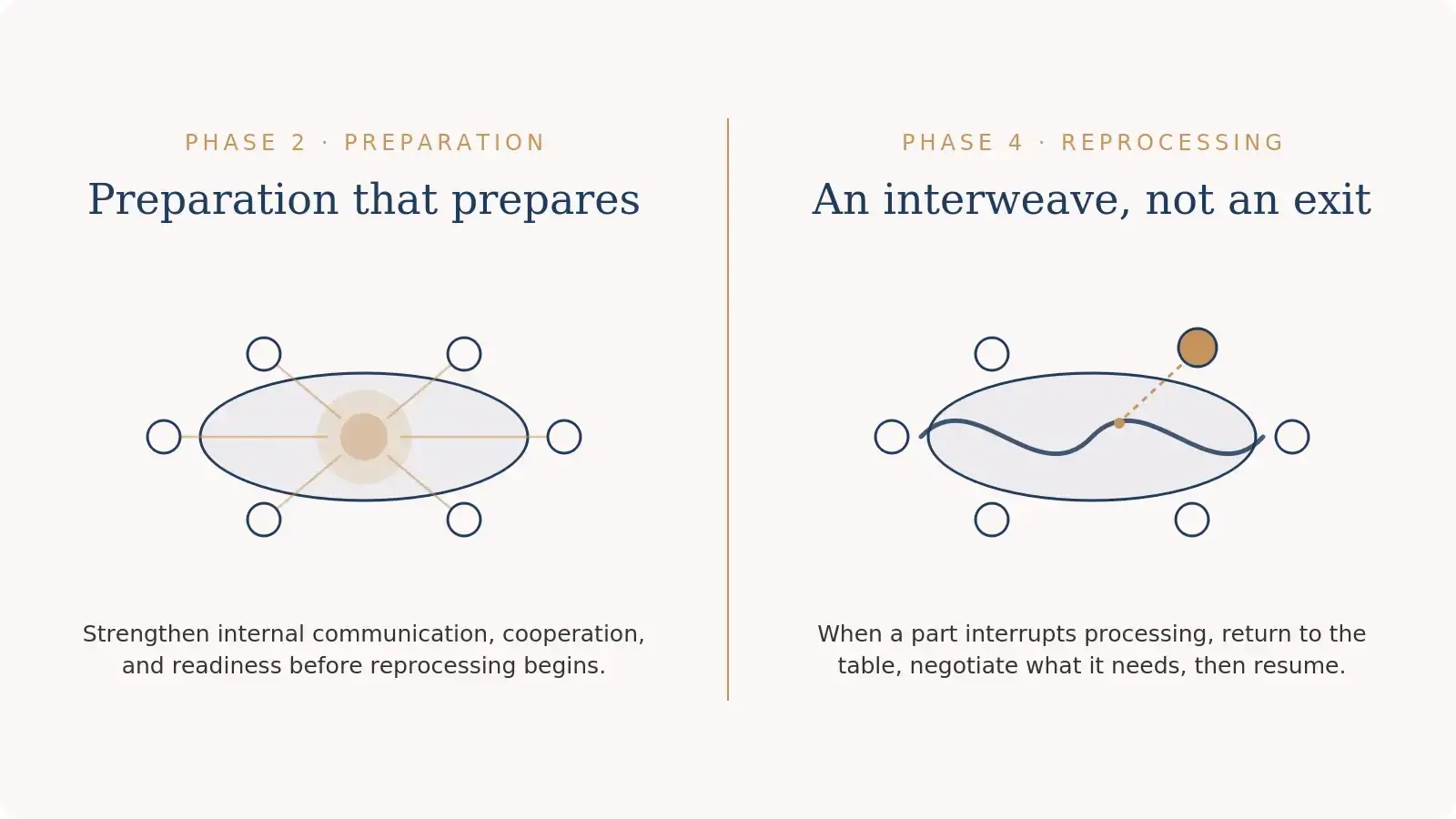
Where the table fits: Phase 2 preparation and Phase 4 desensitization.
Even with careful preparation, parts emerge mid-processing. A client loops on the same image. Affect flatlines or spikes. A voice announces that this is enough, or the client suddenly reports feeling far away. These are the moments when knowing the technique in advance pays off, because the table can function as an interweave rather than an exit from the protocol.
The clinician can briefly return the client to the table to find out who interrupted and what they are protecting against, negotiate what that part needs in order to allow processing to continue, and then resume bilateral stimulation. Handled this way, the interruption becomes information. The part that slammed on the brakes was pointing at the exact material, or the exact fear about the material, that the processing needed to address. Overriding it would have cost you the data and, often, the client’s trust.
The dissociative table is indicated when internal conflict, protective interference, or dissociative responses are shaping the work. It is not a universal opener. Clients with minimal parts activity rarely need it, clients with severe dissociative presentations may need slower stabilization before any table work begins, and clients already fluent in another parts framework may be better served by staying in that language. The clinical skill is less about running the technique than about recognizing the decision points, and that judgment, the competence to match the intervention to the moment, is what separates knowing about parts from working with them.
If your clients arrive speaking IFS language, it is worth knowing that Fraser’s table and Internal Family Systems are distinct frameworks. IFS is a full therapeutic model with its own map of the psyche. The dissociative table is a technique, lighter to deploy and easier to integrate into standard EMDR without changing models. Clinicians who want the deeper integration can explore TTI’s EMDR and IFS Practitioner Program; clinicians who want a tool they can use next week will find the table is often enough.

EMDR Mastermind Series · December 9th
On Wednesday, December 9th at 1:00 PM Central, Rebecca Kase, MSW, LCSW, RYT, founder of the Trauma Therapist Institute and author of Polyvagal-Informed EMDR, will walk through the Dissociative Table Technique inside the EMDR Mastermind Series: how to build the table, invite the parts, and put it to work in Phase 2 and Phase 4, followed by live Q&A for your own cases.
The Mastermind Series is a $49/month subscription, your first month is free, and every session is recorded, so December 9th is included along with the full on-demand library. If parts keep showing up in your EMDR sessions, this is the structured way to meet them.
Fraser GA. The dissociative table technique: a strategy for working with ego states in dissociative disorders and ego-state therapy. Dissociation. 1991;4(4):205-213.
Fraser GA. Fraser’s “Dissociative Table Technique” revisited, revised: a strategy for working with ego states in dissociative disorders and ego-state therapy. J Trauma Dissociation. 2003;4(4):5-28.
Kase R. Polyvagal-Informed EMDR: A Neuro-Informed Approach to Healing. W.W. Norton & Company; 2023.
Piedfort-Marin O, Tarquinio C, Dunezat P. The concept of ego state: from historical background to future perspectives. Eur J Trauma Dissociation. 2020;5(3):100189.