emdr
trauma
emdr training

Stay in the loop
Trauma-informed tools, new trainings, and the occasional pep talk. No spam, ever.


Read Time: 12 minutes
The dominant conversation about therapist burnout tends to focus on the visible inputs: too many clients, too much vicarious trauma, not enough rest, inadequate self-care. These factors are real and well-documented, and the literature confirming their contribution to clinician exhaustion is substantial. The challenge with the dominant conversation is that it tends to be incomplete in a way that leaves clinicians blaming themselves for outcomes that are at least partially structural in origin. A clinician who hears that burnout is caused by inadequate self-care, and who then experiences burnout, is likely to conclude that they have failed to care for themselves adequately. The next move, in many cases, is to redouble efforts at meditation, exercise, and time off, while leaving the structural conditions that produced the exhaustion untouched.
This piece is for clinicians who have done the self-care work and continued to feel depleted, and who suspect that the standard burnout narrative is missing something important. The argument here is that the structural drivers of clinician burnout, the conditions of the practice itself, account for a significant portion of what depletes therapists over the long arc of a career, and that addressing burnout effectively requires engaging those structural conditions with at least as much seriousness as the wellness practices most discussions emphasize.
Clinician burnout is real, widespread, and well-measured. The World Health Organization formally classified burnout as an occupational phenomenon in the eleventh revision of the International Classification of Diseases, defining it as a syndrome resulting from chronic workplace stress that has not been successfully managed. In the mental health professions specifically, prevalence estimates have run between twenty-one and sixty-one percent depending on the study, the setting, and the measure used, with more recent surveys placing the figure for therapists somewhere above fifty percent. Tebra's 2025 research on private practice providers found that therapists reported the highest rate of mental fatigue (77 percent) and the highest rate of motivation loss (55 percent) of any specialty surveyed.
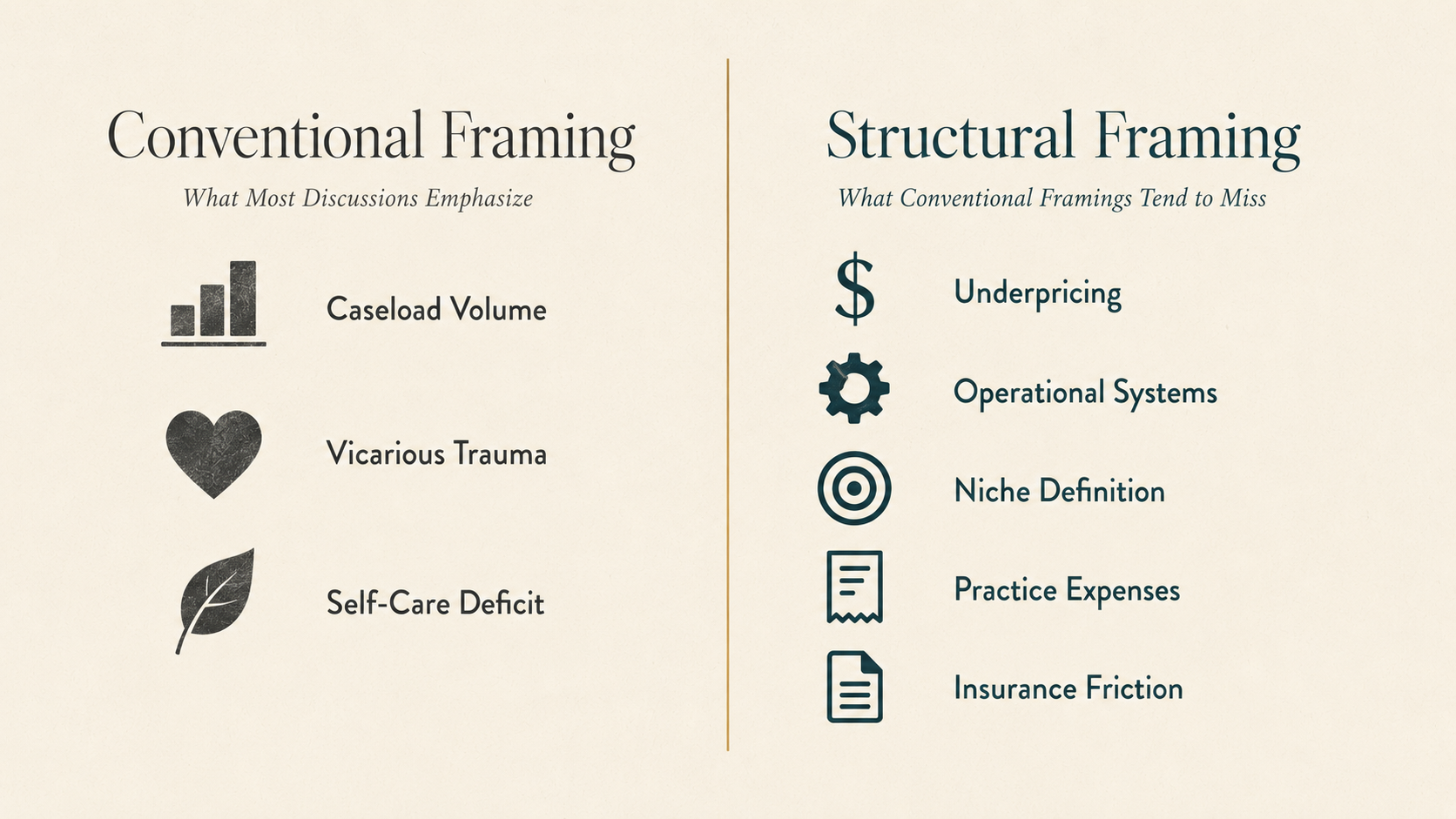
The conventional framing of these numbers tends to emphasize three primary causes. The first is caseload volume, including both the number of clients seen and the clinical severity of the presentations. The second is vicarious trauma and compassion fatigue, the emotional cost of holding clinical material that is by nature difficult. The third is the absence of adequate self-care, framed as a deficit the clinician can correct through behavioral changes around rest, exercise, mindfulness, and time off.
Each of these causes is real, and the research supporting them is solid. A systematic review of burnout prevention strategies identified time off, leisure activities, exercise, and the cultivation of supportive perspective as consistently helpful factors across the qualitative literature. The challenge with stopping the conversation at this point is that these causes are not the whole picture, and treating them as the whole picture tends to leave the structural drivers of burnout unaddressed. A clinician who has good boundaries, takes appropriate time off, and maintains a reasonable self-care practice can still burn out if the underlying structure of their practice is producing chronic pressure they cannot resolve through individual behavior change.
Several structural conditions show up consistently in the practices of clinicians who report burnout, and they tend to operate underneath the more visible inputs in ways that compound over time. Naming them clearly is the first step in working with them rather than around them.

A clinician whose fee is set below what their practice actually needs to sustain them has to see more clients to make the numbers work. This increases the volume of clinical hours per week, which reduces the time available for documentation, consultation, continuing education, and recovery between sessions. The research on therapist burnout is consistent that caseload size and inadequate recovery time are among the strongest predictors of emotional exhaustion. The temptation is to address the resulting depletion through self-care, when the more structurally accurate intervention is to recalibrate the fee so that the practice can hold a sustainable caseload. The pricing question is downstream of the burnout question more often than the burnout question is downstream of the pricing question.
Private practice, by structural design, tends to put the clinician at the center of every operational decision. Scheduling, billing, intake, follow-up, marketing, and the various administrative functions that hold a practice together all flow through the clinician's own time and attention in the absence of deliberate system-building. A clinician who is also the operations manager of their own business is doing two full-time jobs with the cognitive load of both, and the cumulative effect on capacity is substantial. The Tebra 2025 research found that documentation and administrative burden were among the highest-ranked contributors to therapist burnout, ahead of the clinical work itself. Building operational systems that reduce the clinician's continuous involvement in administrative work is a structural intervention on burnout, not a luxury.
Clinicians whose practice serves a wide and undifferentiated range of presentations tend to carry a heavier cognitive load than clinicians who have developed depth within a more focused area. The cognitive cost of holding multiple distinct case conceptualizations across substantively different presentations is real, and it compounds across a full week of sessions. Clinicians with more clearly defined niches tend to develop the kind of pattern recognition that makes complex clinical work less cognitively expensive, which in turn produces more capacity for the parts of the work that genuinely require the clinician's full presence. The literature on clinical specialization and burnout prevention tends to identify role clarity and scope definition as protective factors. An undefined niche is one of the quieter inputs to chronic clinical fatigue.
Many private practices accumulate subscription costs, fees, and overhead expenses over years without the clinician maintaining a clear running picture of what those costs actually total. Electronic health records, telehealth platforms, scheduling software, continuing education subscriptions, professional memberships, insurance premiums, and the various smaller costs of running a clinical practice can collectively account for a meaningful percentage of revenue without the clinician quite registering the cumulative effect. The structural consequence is that the practice needs to generate more revenue than the clinician believes it does, which produces caseload pressure that registers as overwork without ever being identified as a pricing or expense problem. The financial blind spot tends to be downstream of the burnout in ways that are not immediately obvious.
For clinicians who panel with insurance, the structural conditions of reimbursement contribute to burnout in ways the clinical literature has begun to document more clearly. A recent survey by the American Psychological Association of therapists who take insurance found significant reports of inadequate reimbursement, growing administrative burden, and delayed or unreliable payments. This is not a self-care problem. It is a structural condition of the payment system that produces specific, predictable forms of exhaustion in the clinicians operating within it. Addressing this aspect of burnout often requires structural decisions about insurance paneling, billing infrastructure, or transition to a different payment model, rather than additional individual coping strategies.
The case for treating structural sustainability as a clinical and ethical issue rather than a personal wellness one rests on a few observations that tend to be uncontroversial when stated directly. The first is that burned-out clinicians deliver demonstrably less effective clinical work. The research linking clinician burnout to reduced therapeutic outcomes is now substantial enough that the issue can no longer be framed as solely about the clinician's wellbeing. When burnout degrades therapeutic presence, attunement, and clinical judgment, the structural conditions producing the burnout become a clinical issue for every client the burned-out clinician sees.
The second is that clinicians who burn out and leave the field, or who reduce their clinical hours significantly, represent a loss of trained clinical capacity at a time when the mental health workforce is already strained. The structural conditions that produce premature exit from clinical work have downstream effects on access to care that extend well beyond the individual clinician. Sustaining a long, productive clinical career is increasingly a form of professional stewardship in addition to a personal goal.
The third is that the structural conditions of clinical practice are largely within the clinician's deliberate control, even when they do not feel that way in the moment. Pricing, niche, operational systems, expense management, and the payment models a clinician operates within are all decisions that can be examined, calibrated, and changed. They tend to feel fixed because they were set early in the practice and rarely revisited, not because they are actually unchangeable. Treating the structural conditions as deliberate design decisions rather than inherited constraints opens up the possibility of working with them differently.
The work of addressing the structural drivers of burnout tends to look different from the work of addressing the conventional ones. Where conventional interventions focus on the clinician's individual practices around rest, recovery, and emotional regulation, structural interventions focus on the conditions of the practice itself. A few of the most useful starting points are worth naming.
The first is auditing the financial structure of the practice. This involves cataloguing actual annual overhead, calculating what the practice needs to earn for the clinician to live the life they intend to live, and comparing those figures to the current fee schedule and billable hour volume. Most clinicians who do this exercise for the first time discover that their pricing is structurally below what their practice actually requires, and the resulting caseload pressure is one of the drivers of the burnout they have been experiencing as personal exhaustion.
The second is identifying the operational systems that could reduce the clinician's continuous involvement in non-clinical work. Automation of scheduling, billing, and intake; standardization of communication templates; explicit policies around session-related communication outside of session time; and clear systems for documentation can collectively reclaim several hours per week that the clinician has been absorbing as background administrative load.
The third is examining the cognitive load of the current niche or scope of practice. If a clinician is seeing six substantively different clinical presentations across a given week, the cognitive cost is meaningfully higher than for a clinician with a more focused practice. Narrowing the niche over a reasonable timeline, while honoring existing therapeutic relationships, can produce significant capacity gains that show up in the form of more energy for the parts of the work that genuinely require the clinician's full presence.
The fourth is the broader work of practice design, which is the deliberate examination of the structural decisions that shape what the clinician is actually doing day to day. Practice design treats the practice itself as the appropriate intervention point for burnout, rather than treating the clinician's individual coping as the only available lever. The shift in framing tends to produce different and more durable outcomes than the self-care approach, particularly for clinicians who have already worked the self-care angle without resolution.
Why are therapists so burned out? Therapist burnout results from a combination of clinical, emotional, and structural drivers. The clinical and emotional components are well-recognized, but the structural drivers, including underpricing, undefined niche, inadequate operational systems, insurance administrative burden, and uncatalogued practice expenses, tend to receive less attention despite producing substantial cumulative effects on clinician capacity over the course of a career.
What percentage of therapists report burnout? Estimates range from approximately twenty-one to over sixty percent of mental health practitioners reporting burnout, depending on the measure and setting. Tebra's 2025 research found that therapists reported the highest mental fatigue (77 percent) and highest motivation loss (55 percent) of any healthcare specialty surveyed, while broader industry surveys place clinician burnout consistently above fifty percent.
How is structural burnout different from regular burnout? Structural burnout originates in the design of the practice itself rather than in the clinician's individual coping. It manifests as chronic depletion that does not resolve through self-care, time off, or boundary work because the underlying conditions producing it remain unchanged. Addressing structural burnout requires changes to pricing, systems, niche, or payment models rather than additional individual wellness practices.
Can self-care alone resolve therapist burnout? Self-care is necessary but rarely sufficient when burnout has structural drivers. Clinicians who have maintained appropriate boundaries, rest, and recovery practices and continue to experience depletion are usually encountering structural conditions in the practice itself. Resolving this version of burnout requires examining the underlying design of the practice rather than redoubling individual self-care efforts.
How do I know if my burnout is structural? If you have maintained reasonable self-care practices and continue to feel depleted, or if your exhaustion returns quickly after time off, the burnout likely has structural components. A practical diagnostic is to ask whether the conditions of your practice would still feel sustainable if you reduced your caseload modestly. If the answer is no, structural factors are likely contributing.
|
Practice by Design: Building a Sustainable Therapy or Consultation Business is a four-hour workshop where Rebecca Kase, LCSW & CEO works through the structural conditions that produce sustainable clinical practice.
Purpose, the blocking paradigms shaping your business decisions, the four pillars of a functioning practice, and a 90-day pilot plan you can begin executing when you log off. Built specifically for therapists and EMDR consultants who have done the self-care work and want to engage the structural drivers underneath.
Friday, July 31, 2026 at 10:00 AM Central. Live + recorded with lifetime access. $147.
|
|
Want to start with the self-paced version? The Business Accelerator Kit Download is the entry point to the series at $29, including the four-pillar self-assessment and the Hourly Math Worksheet for calibrating the structural conditions underneath your practice.
|
American Psychological Association. (2018, January). Research roundup: Burnout in mental health providers. https://www.apaservices.org/practice/update/2018/01-25/mental-health-providers
Lent, J., & Schwartz, R. C. (2012). The impact of work setting, demographic characteristics, and personality factors related to burnout among professional counselors. Journal of Mental Health Counseling, 34(4), 355-372. https://doi.org/10.17744/mehc.34.4.e3k8u2k552515166
Mullen, P. R., Backer, A., Chae, N., & Li, H. (2024). Effective burnout prevention strategies for counsellors and other therapists: A systematic review and meta-synthesis of qualitative studies. Counselling Psychology Quarterly. https://doi.org/10.1080/09515070.2024.2394767
Tebra. (2025). Physician burnout by specialty 2025: Navigating stress in the healthcare industry. https://www.tebra.com/theintake/staffing-solutions/independent-practices/physician-burnout-by-specialty
World Health Organization. (2019). Burn-out an "occupational phenomenon": International Classification of Diseases. https://www.who.int/news/item/28-05-2019-burn-out-an-occupational-phenomenon-international-classification-of-diseases
Yang, Y., & Hayes, J. A. (2020). Causes and consequences of burnout among mental health professionals: A practice-oriented review of recent empirical literature. Psychotherapy, 57(3), 426-436. https://doi.org/10.1037/pst0000317