
emdr
emdr training
clinical development

Stay in the loop
Trauma-informed tools, new trainings, and the occasional pep talk. No spam, ever.


Reading Time: 9 minutes
If you are EMDR-trained, somatic-trained, or otherwise grounded in trauma-focused work, the first question you usually have about ACT is not what it is. It is whether learning it means giving up what you already do. Most clinicians do not say this out loud, but it sits underneath every conversation about adding a new modality, and it deserves a direct answer.
The short version: no. ACT and trauma processing are not competing modalities. They target different parts of the clinical picture, they integrate well, and most clinicians who use both find that each one strengthens the other. The longer version, which is what this post is about, is worth understanding before you decide whether ACT belongs in your practice.
Trauma clinicians develop a kind of skepticism toward new modalities that gets dismissed as resistance and is actually professional maturity. You have watched approaches come and go. You have seen colleagues swap one shiny framework for another, only to return to fundamentals after two years. You have learned, slowly, that the modalities that survive are the ones that integrate with everything else and do not require you to throw out what works.
So when ACT shows up in your continuing education feed, the doubt you have is reasonable. Will this require me to abandon a treatment approach I have spent years developing? Is this just CBT in a new wrapper? Does it actually do anything trauma processing does not already do?
These are the right questions. They deserve real answers rather than reassurance.
Trauma processing targets the unprocessed memory and its physiological residue. Whether you use EMDR, prolonged exposure, cognitive processing therapy, or a somatic approach, the underlying clinical aim is to help the nervous system metabolize what it could not metabolize at the time. The memory loses its grip. The intrusion symptoms ease. The physiological response settles. This is what trauma processing does, and across the best-studied trauma modalities, the evidence for these effects is robust.
ACT targets the relationship between the client and their internal experience. Not the memory itself, and not the symptoms, but the pattern of how the client relates to the thoughts, feelings, and sensations that arise. The work is to reduce experiential avoidance, to soften cognitive fusion, to clarify values, and to support behavior that moves the client toward what matters even when difficult internal experience is present.
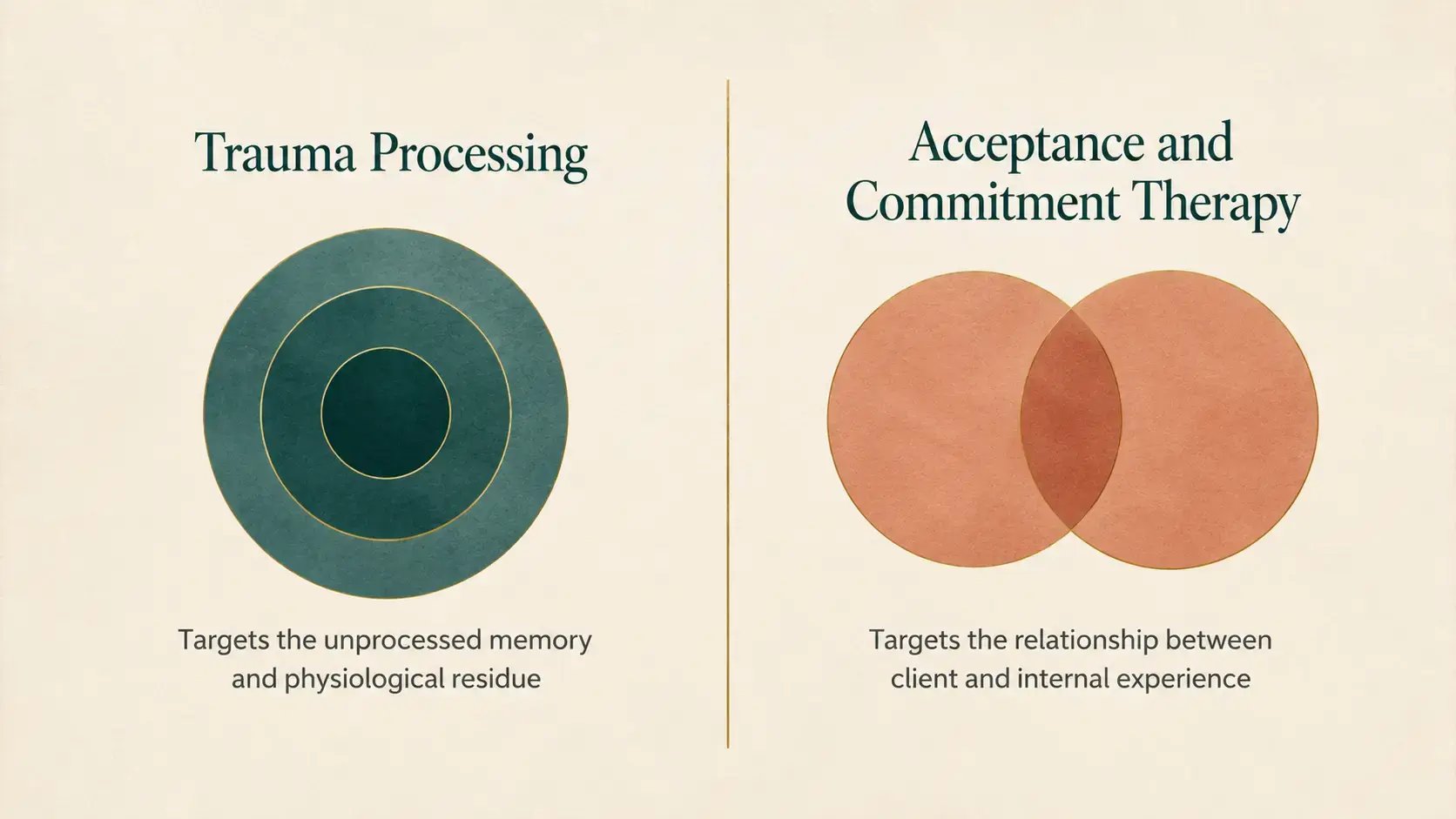
These are not the same target. A client can have a fully processed trauma memory and still be stuck in rumination, perfectionism, or values disconnection. The memory has been metabolized. The relationship to internal experience has not. Conversely, a client can have a clear values direction and a flexible relationship to their thoughts, and still be carrying unprocessed trauma that needs to be addressed directly.
When clinicians describe ACT and trauma processing as competing, they are usually conflating the target with the technique. Both modalities use mindfulness. Both involve some form of exposure. Both work with values, in different ways. The techniques overlap. The targets do not.
There are specific clinical situations where trauma processing alone tends to leave a gap, and where ACT fills it. These are the moments when most clinicians first sense that something is missing from their existing toolkit.
Clients whose symptoms ease but whose suffering remains. The trauma symptoms have shifted. The diagnostic picture looks different. And yet the client returns, week after week, with the same rumination, the same harsh inner narration, the same avoidance organizing their week. The trauma work was thorough. The suffering surrounds it.
Clients who dissociate during processing. The standard preparation phase of EMDR or other trauma-focused work often does not give clients enough tools to manage dissociation when it shows up mid-session. ACT's defusion and self-as-context skills give clients structured ways to create distance from intrusive content while staying present.
Clients whose avoidance keeps them out of the room for the work they came for. Some clients cancel sessions. Others stay engaged but cannot bring themselves to approach the targets that matter. Acceptance and willingness skills give these clients a different orientation to the experience of discomfort itself.
Clients who have lost contact with values. After years of organizing around survival, some clients arrive without a clear sense of what they actually want from their lives. Trauma processing alone does not always restore that sense of direction. Values clarification often does.
Clients in chronic illness or other unresolvable circumstances. When symptom reduction is not a realistic goal, the question shifts from how to make the suffering go away to how to live alongside it. ACT was built for this kind of clinical situation, and the research base supporting it for chronic illness populations is one of the strongest in the literature.
If this section feels like it tilts the post toward ACT, it should not. ACT alone is not always enough, and clinicians who try to use it as a standalone treatment for clients with unprocessed trauma often discover the limits quickly.
Acceptance of trauma symptoms is not the same as processing them. A client can develop genuine willingness to feel the anxiety, the fear, the body memory, and the memory will still continue to fire in the same way until something fundamental shifts in how it is stored. Trauma-focused modalities work at the level of the memory itself, in ways that ACT does not.
Values-based action also has limits when the nervous system is still organized around survival. A client whose autonomic system is in chronic dorsal vagal shutdown or chronic sympathetic activation cannot easily access values, much less act on them. Trauma processing is sometimes what makes ACT possible. Stabilization first, processing where indicated, then values-based work has the room to land.
Naming where ACT reaches its limit matters because it is what separates an honest evaluation of the model from a sales pitch. ACT is one tool in a thoughtful trauma clinician's set. It is not a replacement for any of the others.
Clinicians who use both ACT and trauma processing tend to integrate them in one of three ways. Each model has a logic, and each fits some clients better than others.

Stabilization with ACT, then trauma processing, then return to ACT. The clinician uses early sessions to build acceptance, defusion, and mindfulness skills as part of a robust preparation phase. Trauma processing happens in the middle of treatment, once the client has the regulatory capacity to tolerate it. Late-stage work returns to values clarification, committed action, and the rebuilding of a life that the trauma had organized around survival.
ACT skills used in service of trauma processing. The clinician folds defusion into Phase 2 EMDR preparation, uses acceptance language during reprocessing, and brings values clarification into closure work. The trauma modality remains the primary frame. ACT skills are woven through the protocol as needed.
Both modalities held simultaneously, with the clinician moving fluidly between them based on what shows up in the room. This requires deeper fluency in both approaches and tends to be how experienced clinicians work after several years of holding both lenses. The clinical decision in any given moment is not which model to use but which process to engage.
None of these models is correct. Different clients call for different patterns of integration, and the clinician's own training, supervision, and clinical judgment guide the choice.
Yes, and many clinicians do exactly this. ACT skills support every phase of the EMDR protocol. Acceptance and defusion strengthen Phase 2 preparation. Mindfulness and present-moment skills help clients stay regulated during reprocessing. Values clarification anchors the work over time. EMDR-trained clinicians who add ACT typically find that the two modalities reinforce one another rather than compete, and that ACT gives them a coherent framework for the suffering that surrounds trauma symptoms.
If you have read this far still wondering whether you have to choose between ACT and trauma processing, the answer is no. The choice is not between modalities. It is between staying within a single model and developing the flexibility to draw from multiple frameworks based on the client in front of you.
That flexibility is itself a kind of psychological flexibility. The clinician who can hold multiple lenses without becoming fused with any one of them tends to do the best work over time. The clinician who needs to be right about which modality is best tends to get rigid, and rigidity in the therapist is one of the most reliable predictors of treatment stalling.
If you are curious about how ACT might fit alongside the trauma work you already do, our 1-Day Fundamentals Course for Trauma Clinicians with Jennifer Caspari, PhD is built for clinicians in exactly your position.
Hayes, S. C., Strosahl, K. D., & Wilson, K. G. (2012). Acceptance and commitment therapy: The process and practice of mindful change (2nd ed.). Guilford Press.
Mendes, A. L., & Castilho, P. (2022). The emerging role of acceptance and commitment therapy as a way to treat trauma and stressor-related disorders. Frontiers in Psychology. https://pmc.ncbi.nlm.nih.gov/articles/PMC8771204/
Rehman, S., Ghazali, S. R., & Elklit, A. (2026). A systematic and meta-analytical review of Acceptance and Commitment Therapy for PTSD. Journal of Loss and Trauma, 31(1), 90-119. https://doi.org/10.1080/15325024.2025.2565354
Schnurr, P. P., Chard, K. M., Ruzek, J. I., et al. (2022). Comparison of prolonged exposure vs cognitive processing therapy for treatment of posttraumatic stress disorder among US veterans: A randomized clinical trial. JAMA Network Open, 5(1), e2136921. https://doi.org/10.1001/jamanetworkopen.2021.36921
