Addiction as Dissociation: Rethinking Trauma and EMDR Treatment in Addiction Care
Mar 12, 2026
Written By: The TTI Team
Read Time: 10 minutes
Why Addiction Work Needs Dissociation-Informed Training
Your client, Michael, has been sober for 47 days. He's doing everything right, meetings, grounding exercises, check-ins. Then Thursday, he relapses. When you see him the following week, he looks genuinely confused. "I don't know what happened. One minute I was fine, and the next I was already high. Like I watched myself do it but couldn't stop."
You've heard this story dozens of times. The "I don't know what happened" relapse. Watching yourself use from outside your body. The disconnect between intention and action.
Most addiction frameworks call this denial or resistance. But what if it's actually dissociation?
Addiction is often a trauma-linked, survival-driven pattern, not bad choices. Studies show 70-90% of people with substance use disorders have histories of adverse childhood experiences. The addiction isn't separate from trauma, it's a response to it.
And here's the game-changer: addictive behavior functions as a state shift away from overwhelming affect, body sensations, and memory. It's numbing, spacing out, losing time, feeling detached. That's trauma-related dissociation.
The clinical gap: most EMDR and trauma therapists were under-trained in dissociation and even less prepared for its relationship to addiction. This fuels hesitancy around using EMDR with active or recent substance use, leading us to either avoid trauma processing or proceed without the adaptations these clients need.
The "Addiction as Dissociation" Model in Simple Clinical Language
Dr. Jamie Marich and colleagues developed the "addiction as dissociation" model, fundamentally reframing how we conceptualize substance use in trauma survivors.
Core idea: addiction is a manifestation of clinically significant dissociation, rooted in unhealed trauma. The substance or behavior becomes a "part" or state that takes over to protect the system from intolerable internal experience.
Think about what happens when someone uses. The nervous system shifts. Affect numbs. Body sensations are dull. Painful memories become less accessible. Time distorts or disappears. The person might describe feeling like "a different version of myself" because neurobiologically, they are.
This isn't a metaphor. It's dissociation.
When you frame it this way, case conceptualization transforms. Instead of seeing relapse as resistance, you recognize it as a dissociative protection strategy. The system does what it learned when overwhelmed: fragment, numb, escape into an altered state.
That shift from "you're choosing to use" to "a part of you is protecting you from something unbearable" opens entirely different clinical pathways. You work with curiosity instead of confrontation. You ask, "What is this part protecting you from?" not "Why aren't you trying harder?"

This aligns with contemporary EMDR views of dissociation as discontinuity in consciousness, identity, and affect integration. It's not just spacing out - it's a fundamental breakdown in how experience gets integrated, exactly what we see in trauma-based dissociation and addictive patterns.
How Dissociation Changes EMDR Planning in Addiction Settings
When you understand addiction through a dissociation lens, your entire EMDR treatment planning shifts.
Assessment Before Activation
You can't just jump to trauma processing. First, you need to map the dissociative landscape. Which parts or states are present? How does the "using self" function? What triggers shifts into addictive states? What does the client remember versus what gets lost in dissociative gaps?
Specific attention goes to:
- Dissociative symptoms (depersonalization, amnesia, identity confusion)
- Parts or self-states (including the "using part")
- What activates addictive states versus what supports sobriety
Stabilization and Resource Development
Standard Phase 2 work isn't enough. You need to explicitly include the addictive parts and states in resource development. That means:
- Teaching grounding that works for both hyperarousal and hypoarousal (because addiction often lives in the shutdown, numbed-out space)
- Building resources that speak to craving states, not just anxiety or anger
- Working with shame-laden younger parts who believe they deserve the pain substances temporarily erase
- Facilitating internal negotiation between parts that want recovery and parts that want to use
Practical Adaptations for Addiction Clinicians
Dissociation-informed EMDR in addiction settings requires specific modifications:
Modified bilateral stimulation: When dissociation or craving spikes during processing, you need slower, lighter, shorter sets. You're titrating exposure carefully, watching for signs the client is drifting too far out of their window.
Strategic target selection: You're choosing targets based on system readiness, not just clinical logic. Early trauma? Yes, but only when protective parts agree. "First use" memories? Powerful, but often heavily defended. Worst consequences? Sometimes, if the client can stay present. Current triggers? Often the safest place to start.
The key is reading the system's signals. When a part activates mid-session, when the effect suddenly flattens, when the client says "I'm fine" but their body language screams dissociation, these are clinical decision points that basic EMDR training doesn't adequately prepare you for.
This is why clinicians need dissociation EMDR therapist training specific to these presentations, not just standard protocols plus good intentions.
Clinical Red Flags: When Addiction Is Actually Dissociation
Here's what to watch for in addiction treatment settings that signals you're dealing with dissociation, not just substance use:
"Going away" during or around use
- Client describes watching themselves use, like an observer
- Feeling completely detached from the decision to use
- Experiencing themselves as "a totally different person" when using
Significant time loss
- Fuzzy or missing memories around use episodes
- "I decided not to use, but next thing I knew I was high"
- Can't account for hours or days during active use periods
Rapid state shifts
- Dramatic changes in affect, posture, or worldview when discussing trauma
- Sudden shifts when cravings activate or recovery commitments are mentioned
- Different "versions" of the client showing up session to session
These aren't character flaws or manipulation. They're dissociative symptoms requiring specific clinical competencies.
Here's the risk: without dissociation-specific training, EMDR on addiction and trauma can flood the system, destabilize the client, or get completely misinterpreted as "non-compliance." You might think the client isn't trying when actually a protective part is blocking access to the very memories you're trying to process. You might increase bilateral stimulation intensity when the client needs slower, gentler pacing. You might interpret switching between states as resistance when it's survival-based dissociation doing exactly what it was designed to do.
Why Standard Addiction Training Isn't Enough
Traditional addiction models, disease, moral, purely behavioral, don't account for dissociation. Many programs still underemphasize trauma processing entirely.
Clinicians feel stuck between abstinence requirements, program pressures, and an intuitive sense that "something dissociative is happening." But they lack the framework and tools to work with it.
The 12-step model talks about powerlessness. Behavioral models focus on contingency management. Motivational interviewing addresses ambivalence. All useful, but none directly address what happens when a traumatized nervous system fragments into states that use substances to dissociate from unbearable experience.
Dissociation trauma therapist training fills this gap with language ("that's a part activating"), assessment tools that identify dissociation in addiction contexts, and pacing strategies that integrate trauma work, addiction treatment, and EMDR without destabilization.
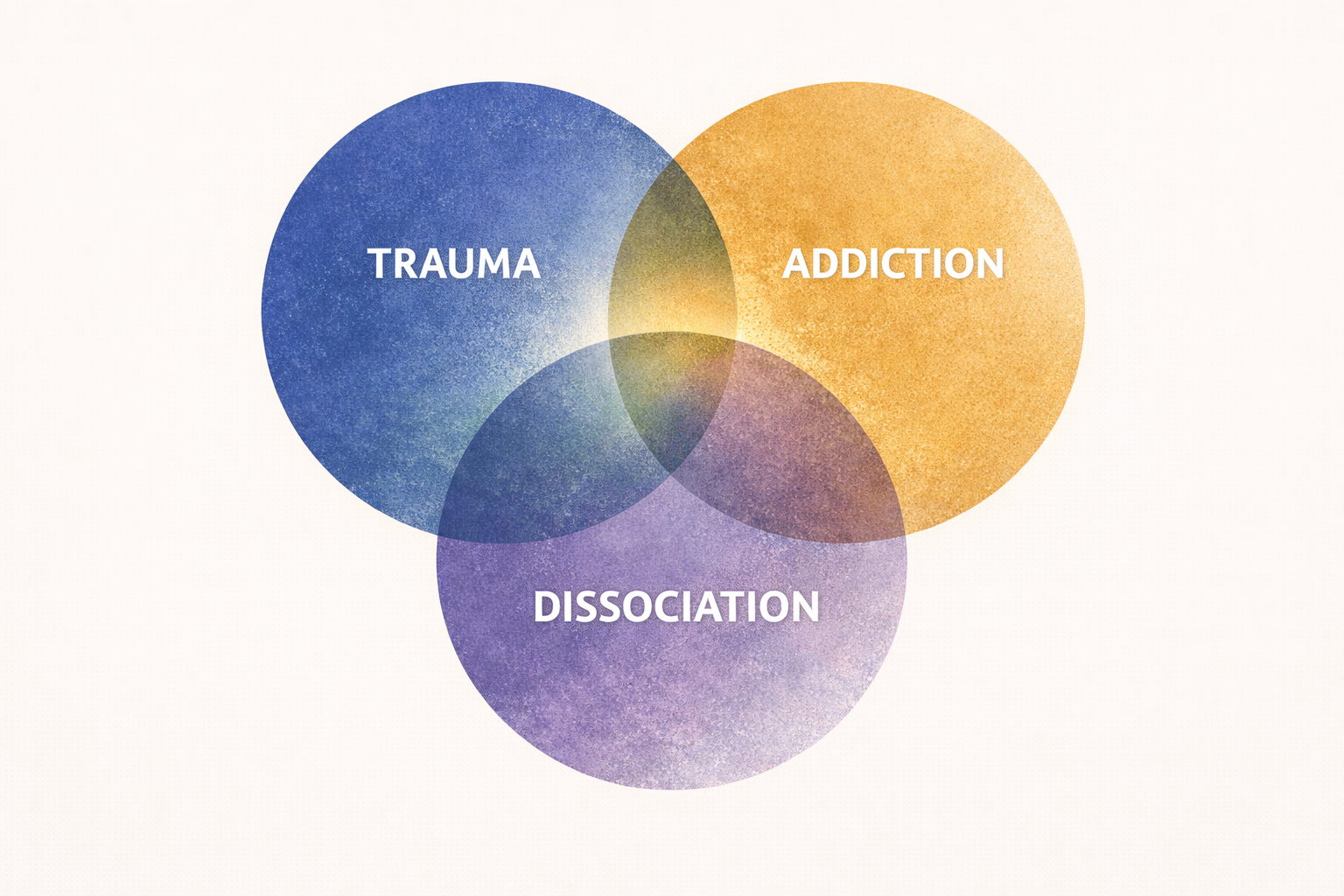
Core Competencies for Dissociation-Informed Addiction and EMDR Work
What does competent practice actually look like when you're working at the intersection of trauma, addiction, and dissociation?
Assessment and Conceptualization
Clinical interviewing plus screening tools. You're not just asking about substance use patterns and trauma history. You're specifically screening for dissociative symptoms using tools designed for this population. You're asking about time loss, parts, state shifts, and the phenomenology of using ("What does it feel like right before you use? During? After?").
Mapping dissociative profiles. You're creating a map of the internal system alongside the addiction pattern. Who are the parts or states? How do they relate to each other? Which ones hold trauma memories? Which ones use substances? How does the "sober self" relate to the "using self"? What are the triggers that activate shifts between states?
This isn't extra work. It's an essential assessment that tells you whether standard EMDR will work or whether you need significant adaptation.
Safety, Stabilization, and Pacing
Competence includes pacing. This phrase matters. You're staying within the client's window of tolerance, which is often quite narrow when withdrawal, cravings, or co-occurring disorders are active. You're recognizing that pushing too fast doesn't demonstrate clinical courage it demonstrates clinical naivety about how dissociative systems work.
Containment, grounding, and resourcing. You're developing skills that speak to both dissociative parts and addictive urges. That means grounding techniques that work for hypoarousal (not just the standard "5-4-3-2-1" which assumes the client is activated rather than shut down). It means resources that address shame, not just fear. It means teaching parts to communicate internally so the system doesn't have to fragment quite so dramatically to manage conflict.
EMDR-Specific Skills
Readiness assessment. You're not assuming that completing Phase 1 and 2 means automatic readiness for Phase 3. You're specifically assessing: Does the client have adequate affect tolerance? Can they stay grounded when triggered? Is there internal agreement about working on trauma, or will protective parts shut down the process? Are they stable enough in recovery that trauma processing won't immediately trigger relapse?
Dissociation-informed adaptations. You're using modified bilateral stimulation when needed. You're employing interweaves tailored to parts and states ("What does the part that users need right now?" "What does the younger part who holds this memory want the adult part to know?"). You're implementing closure protocols that specifically address the risk of using after difficult sessions.
Training programs like Clinical Competencies in Treating Dissociative Identities help clinicians build exactly these competencies, not as theoretical knowledge, but as practical, in-session skills.
Lived Experience, Stigma, and Language in Addiction-Dissociation Work
Language matters immensely here.
When we center lived experience of both dissociation and addiction, we challenge stigmatizing labels: "chronic relapser," "borderline," "manipulative," "non-compliant." These pathologize survival strategies and obscure dissociative processes.
A survival-based frame sounds different: "This part is protecting you." "Your nervous system learned to use substances to manage overwhelming states." "The using self and recovery self haven't figured out how to coexist yet."
Using client-centered language for parts matters too. Some clients resonate with "the using self" or "the part that numbs out." Others prefer "protector" or "younger me." You're meeting clients in their phenomenology, not imposing diagnostic labels.

Dr. Marich's openness about her dissociative disorder has helped normalize these conversations. When a respected clinician says, "I experience dissociation, and here's how I understand it from both clinical and lived perspectives," it reduces shame for clients and therapists alike.
How Specialized Training Supports EMDR and Trauma Therapists in Addiction Work
The Clinical Competencies in Treating Dissociative Identities: Bridging Lived Experience and Science training addresses exactly what addiction clinicians need:
Focus on dissociation across a spectrum. This isn't only about DID. It's about recognizing dissociative patterns wherever they show up, which is constantly in addiction settings, even when clients don't meet full diagnostic criteria for a dissociative disorder.
Assessment before activation. You learn how to thoroughly assess before processing, which is essential when clients use substances to manage internal states. You can't just assume Phase 2 stability means readiness for trauma work. You need to know how to evaluate the whole system.
Phase-specific EMDR adjustments. The training covers adaptations across all eight phases, with specific attention to dissociation-sensitive risk reduction. This is crucial when working with clients whose primary coping mechanism for overwhelm has been substances.
Who should attend:
If you're an EMDR clinician in community mental health, harm-reduction programs, or residential treatment seeing dissociation but unsure how to proceed, this training is for you.
If you're a trauma therapist without EMDR training who wants a dissociation-informed lens for conceptualizing the addiction cases in your caseload, this gives you that framework.
If you've been avoiding trauma processing with clients who have substance use disorders because you're worried about destabilization, this teaches you how to work safely and effectively.
Trainer authority matters. Dr. Marich has written extensively on EMDR, trauma, addiction, and dissociation. She co-developed the "addiction as dissociation" model. She's received recognition from EMDRIA and major outlets for her work. And she brings lived experience of dissociation to her teaching, which adds depth and humanity that purely academic training can't provide.
Frequently Asked Questions
Why is it helpful to see addiction as a form of dissociation?
Viewing addiction through a dissociation lens shifts treatment from confrontation to collaboration. Instead of seeing substance use as willful resistance, you recognize it as a nervous system survival strategy, a way of fragmenting away from unbearable internal experience. This reframe opens up trauma-informed, dissociation-competent interventions that address the root protective function of addiction rather than just targeting the behavior. It also reduces shame for both clients and therapists, positioning relapse as information about unhealed trauma rather than moral failure.
Do I need advanced dissociation training before using EMDR with clients who have addictions?
If you're seeing dissociative symptoms, time loss, parts, rapid state shifts, "watching myself use" then yes, you need dissociation-specific competencies beyond basic EMDR training. Standard EMDR protocols don't adequately address the complexity of working with clients who use substances to dissociate from trauma. Without proper training, you risk flooding, destabilization, or misinterpreting dissociative responses as resistance. Advanced training teaches you how to assess readiness, modify protocols, and work collaboratively with parts or states.
How does dissociation-informed EMDR change the way I plan treatment for clients with trauma and addiction?
It fundamentally changes assessment, pacing, and adaptation. You start by mapping the dissociative system alongside addiction patterns. You explicitly include addictive parts in stabilization work. You modify bilateral stimulation based on dissociative responses. You select targets based on internal system readiness, not just clinical logic. You implement closure protocols that specifically address post-session vulnerability to using. The entire treatment becomes more collaborative, slower-paced, and attuned to how the nervous system uses both substances and dissociation to manage overwhelm.
Your Next Step as a Trauma Therapist in Addiction Settings
If you work with clients who have both trauma and substance use disorders, you're already encountering dissociation.
The clients who relapse and can't explain why. The ones who describe using it as "watching myself from outside my body." The ones whose presentation shifts dramatically when you approach certain topics. The ones with distinct "sober self" and "using self" states that don't communicate.
That's dissociation. And standard addiction treatment plus basic EMDR training aren't enough.
USA-based EMDR and trauma clinicians now have access to specialized dissociation therapist training addressing addiction and EMDR integration. You don't have to choose between trauma processing and addiction stabilization when you have dissociation-informed competencies.
This isn't about becoming a specialist. It's about building core skills for the clients already in your practice, the ones in residential treatment, harm reduction programs, and community mental health, waiting for clinicians who understand that their addiction is dissociation, their dissociation is trauma, and all of it is survival.
Ready to integrate dissociation-informed approaches? The Clinical Competencies in Treating Dissociative Identities training gives you practical tools for trauma, addiction, and dissociation. Learn evidence-based adaptations, earn CE credits, and join trauma therapists expanding their scope. Registration is open now.
References
Clinical Competencies in Treating Dissociative Identities. (2019). Traumatherapistinstitute.com. https://www.traumatherapistinstitute.com/Clinical-Competencies-in-Treating-Dissociative-Identities-Bridging-Lived-Experience-and-Science-For-the-Trauma-Therapist
Greene, J., Graham, J., Gulnora Hundley, Zeligman, M., Bloom, Z., & Ayres, K. (2018). Counseling Clients with Dissociative Identity Disorder: Experts Share their Experiences. Journal of Counselor Practice, 9(1), 39–63. https://doi.org/10.22229/zpe728029
International Society for the Study of Trauma and Dissociation. (2011). Guidelines for Treating Dissociative Identity Disorder in Adults, Third Revision. Journal of Trauma & Dissociation, 12(2), 115–187. https://doi.org/10.1080/15299732.2011.537247
Marich, J., & Wagner, A. (2021, December 14). Advanced Certificate in Dissociation Studies for EMDR Therapists. The Institute for Creative Mindfulness. https://www.instituteforcreativemindfulness.com/advanced-certificate-in-dissociation/
Subramanyam, A., Somaiya, M., Shankar, S., Nasirabadi, M., Shah, H., Paul, I., & Ghildiyal, R. (2020). Psychological Interventions for Dissociative disorders. Indian Journal of Psychiatry, 62(8), 280. https://doi.org/10.4103/psychiatry.indianjpsychiatry_777_19
The Art and Science of EMDR. (2024, February 17). Dr. Jamie Marich on EMDR and Dissociation. YouTube. https://www.youtube.com/watch?v=6vcto4c3Pwo
van der Kolk, B. A., & van der Hart, O. (1989). Pierre Janet and the breakdown of adaptation in psychological trauma. The American Journal of Psychiatry, 146(12), 1530–1540. https://doi.org/10.1176/ajp.146.12.1530
Van Der Kolk, B., & Van Der Hart, O. (n.d.). Pierre Janet & the Breakdown of Adaptation in Psychological Trauma. https://traumaresearchfoundation.org/wp-content/uploads/2021/05/janet_am_j_psychiat.pdf
Dansiger, S. (2019). Stephen Dansiger. Stephen Dansiger. https://www.drdansiger.com/healing-addiction-with-emdr-therapy-book
Stay connected with fun info, news, promotions and updates!
Join our mailing list to receive the latest news and updates from our team.
Don't worry, your information will not be shared.