Exploring the DeTUR Protocol: An Overview to Urge Reduction
Jan 03, 2025
Read Time: 15 minutes
Written By: The TTI Team
Internet addiction is a growing concern in our digital age, affecting many lives daily. As we spend increasing hours online, many struggle to balance their digital habits with reality. Understanding this addiction is vital for developing effective strategies to manage it. One such strategy gaining traction is the DeTUR Protocol, specifically designed to help individuals reduce urges related to internet addiction and other compulsive behaviors.
For clinicians seeking specialized EMDR training to address addiction, understanding the DeTUR Protocol is essential. This approach has roots in established therapeutic practices but focuses more on the unique challenges posed by screen time, substance use, and other compulsive engagements. By breaking down its components, trauma therapists can better understand how it works and when to apply it in their addiction treatment practice.
In this article, we will explore the DeTUR Protocol, from its origins to its practical applications, and even the empirical research backing it. We'll discuss how it compares to traditional methodologies and provide insights into implementing this effective tool in addiction recovery. Whether you're looking for addiction training for therapists or seeking to expand your EMDR expertise, this comprehensive overview will equip you with the knowledge you need.
Understanding Internet Addiction Disorder
Understanding Internet Addiction Disorder (IAD) requires a nuanced approach to treatment. IAD is characterized by excessive or poorly controlled preoccupations, urges, or behaviors regarding internet use that lead to distress or impairment. Dysfunctional behaviors are at the core of IAD where individuals may turn to the digital world to escape real-life challenges, leading to desensitization of triggers that can exacerbate the disorder. For clinicians seeking to develop expertise in treating addiction with EMDR, specialized addiction training for therapists provides the protocol knowledge and neuroscience foundations needed for effective treatment.
Key Features of IAD:
- Persistent online activity despite negative consequences
- Withdrawal symptoms when internet access is restricted
- Build up of tolerance; more time needed online to feel satisfied
- Reduction in social, academic, or occupational activities due to internet use
- Deception about the extent of internet engagement
The positive treatment goal in dealing with IAD often involves the urge reduction protocol. This encompasses developing internal resources and empowering the individual to gain control over their compulsive behaviors. Techniques such as Ericksonian hypnosis have been noted for their potential in supporting clients to access internal strength and redirect focus.
Robbie Dunton, along with others skilled in EMDR Professional Training, emphasizes the importance of targeting addiction memories and core issues that fuel compulsive internet use. The treatment of addictions through protocols like EMDR Solutions has shown a wide range of success for disorders including, but not limited to, pathological gambling and chemical addictions.
Brief interventions aimed at client empowerment through resource accessing are emerging as effective strategies for mitigating the negative impact of internet addiction and promoting a balanced online presence.

The DeTUR Protocol Explained
When we talk about innovative interventions like the DeTUR Protocol, it's essential to start with a clear understanding of what it is. The DeTUR Protocol stands for 'Desensitization of Triggers and Urge Reprocessing' and is heralded as an effective urge reduction protocol. It's primarily used to tackle dysfunctional behaviors associated with various addictions and compulsive behaviors. What this approach does is target the triggers that elicit negative or destructive behaviors and work on reducing the intense desire to engage in such activities.
One of its notable strengths is that it aims not just to manage but also to diminish the power these triggers hold over an individual. By employing this method, practitioners can help their clients associate triggers with positive and empowering experiences instead, fostering meaningful and lasting change.
This treatment is firmly rooted in the idea of client empowerment, recognizing the importance of nurturing internal resources that individuals can draw upon in their journey to recovery. Through the proficiency of therapists trained in modalities like EMDR Professional Training, DeTUR can be a powerful addition to the suite of interventions for successful treatment of addictions and related behaviors.
Origins of the DeTUR Protocol
The beginnings of the DeTUR Protocol can be traced back to the work of Francine Shapiro, who developed Eye Movement Desensitization and Reprocessing (EMDR), and Robin Shapiro (no relation), who expanded on it. Francine Shapiro's discovery of EMDR's effectiveness in treating post-traumatic stress disorder laid the groundwork for further innovations such as the DeTUR Protocol. This approach was specifically tailored to address the unique challenges presented by chemical addictions, compulsive behaviors, and the associated dysfunctional behaviors.
It has since evolved to be applied across a spectrum of issues, including but not limited to, core traumas and military base-related stress cases. Marilyn Luber, notable for her work in this field, along with Robbie Dunton and others, have played pivotal roles in promoting and refining this specialized protocol within EMDR solutions. Today, clinicians can access comprehensive EMDR training focused specifically on addiction protocols, including DeTUR, FSAP, and other evidence-based interventions for substance use disorders.
Key Components of the Protocol
Within the DeTUR Protocol, there are several essential elements that contribute to its efficacy:
- Identification of Triggers: The first step involves identifying specific internal or external triggers that lead to unhealthy urges.
- Positive Goal Setting: The client is encouraged to establish a positive goal to aspire to, replacing the adverse reactions to triggers with this aspirational objective.
- Desensitization: Utilizing EMDR techniques, the protocol works to lessen the emotional charge of triggers.
- Urge Reprocessing: This phase aims to alter the client's response to triggers by attaching new, more adaptive beliefs and emotions.
- Resource Development: Foster internal resources for empowerment and resilience, aiding in the long-term maintenance of treatment gains.
- Empowerment through Action: Encourage taking actionable steps towards the positive goal, reinforcing empowerment.
Through the strategic application of the DeTUR Protocol's components, therapists can assist individuals in building stronger defenses against addiction memories, and trigger reactions, enabling a smoother path to recovery and self-management.
Mastering DeTUR: Advanced Training for Addiction Work
While understanding the theory behind DeTUR (Desensitization of Triggers and Urge Reprocessing) is valuable, effectively implementing this protocol in clinical practice requires specialized knowledge and hands-on training that goes beyond basic EMDR certification.
Why Specialized Training in Addiction Protocols Matters
The DeTUR Protocol addresses a specific mechanism in addiction that standard EMDR training doesn't fully prepare clinicians to work with: the desensitization of urge triggers and the reprocessing of craving memories. Working with clients struggling with substance use disorders, behavioral addictions, or compulsive behaviors demands:
- Understanding of addiction neurobiology – How cravings form, how the brain's reward system is hijacked, and how to work with dysregulated nervous systems
- Protocol fidelity with flexibility – Knowing when to follow DeTUR step-by-step versus when to adapt based on client presentation
- Integration skills – Combining DeTUR with other addiction-focused protocols like FSAP, CravEx, and the innovative Buzzkill technique
- Preparation strategies – Building sufficient nervous system stability before targeting urges
- Relapse prevention planning – Using future templates and other tools to maintain gains
Steps Involved in the DeTUR Protocol
Embarking on the DeTUR Protocol journey, clients and therapists work closely through a series of structured steps. Essential to the process is establishing trust, assessing historical patterns of addiction, identifying trigger cues, and actively working toward desensitizing these triggers. Central to DeTUR’s approach is the focus on positive treatment goals that empower the individual to tap into their internal resources. Throughout these stages, clients gain skills to manage their reactions to addictive behaviors and ultimately aim for successful treatment outcomes. Let's delve into the specific steps this process entails.
Rapport building with clients
The initial and arguably most impactful phase within the DeTUR Protocol is building a strong rapport between the therapist and the client. This stage is vital for ensuring that clients feel safe, understood, and supported, a necessary foundation for effective therapy. Establishing trust paves the way for open communication and eases the exploration of sensitive issues. Therapists engage clients with empathy, validating their experiences and emotions. It’s during this time that the groundwork of client empowerment begins, leading to the reinforcement of positive self-regard and setting the scene for active collaboration in the treatment process.
Conducting a history assessment
A thorough history assessment is the next step, which involves the therapist and client working jointly to uncover past behaviors, experiences, and events that contribute to current addictive patterns. The essence of this stage is to explore the client's life context and establish the core issues or core traumas that may underpin the addiction. This assessment helps in tailoring the subsequent steps of the protocol to the individual's unique experiences. Through this meticulous evaluation, therapists can formulate a more strategic approach to address the addiction memories and behaviors in question.

Identifying and desensitizing urge triggers
With a foundation of trust and a comprehensive history in place, the focus shifts to pinpointing specific triggers for compulsive behaviors. These triggers may be environmental cues, emotional states, or thought patterns related to dysfunctional behaviors. Once identified, the DeTUR Protocol employs elements of eye movement desensitization to help clients work through and reduce the power of these urges. By pairing the recall of these triggers with bilateral stimulation, clients experience the desensitization of triggers, which lessens their impact and frequency over time. This critical phase is designed to minimize the visceral reaction to triggers, leading clients toward emotional stability and freedom from urge-driven behaviors.
Empirical Research Supporting the DeTUR Protocol
Empirical research has begun to shed light on the DeTUR Protocol, standing for Desensitization of Triggers and Urge Reprocessing. It’s an urge reduction protocol aimed at dysfunctional behaviors often linked to substance use and compulsive behaviors. Developed within the EMDR (Eye Movement Desensitization and Reprocessing) framework, created by Francine Shapiro, DeTUR focuses on desensitizing triggers and reprocessing the urge until it’s no longer dysfunctional, aligning with positive treatment goals.
Evidence suggests DeTUR can significantly contribute to client empowerment, coupling desensitization with the accessing of internal resources for empowerment. It goes hand-in-hand with Ericksonian hypnosis and other empowering approaches. The protocol is crafted to address a wide range of chemical addictions and compulsive behaviors, from eating disorders to pathological gambling.
While research is still evolving, early findings indicate DeTUR can effectively complement the successful treatment of addictions, potentially improving outcomes for individuals facing these challenges. Pioneers like Robin Shapiro, who continues to refine EMDR therapy with resources like "EMDR Solutions," and Marilyn Luber, whose works often serve therapists on military bases and those dealing with post-traumatic stress disorder, add credibility to the protocol’s efficacy in empirical research.
Table: Key Findings in DeTUR Research
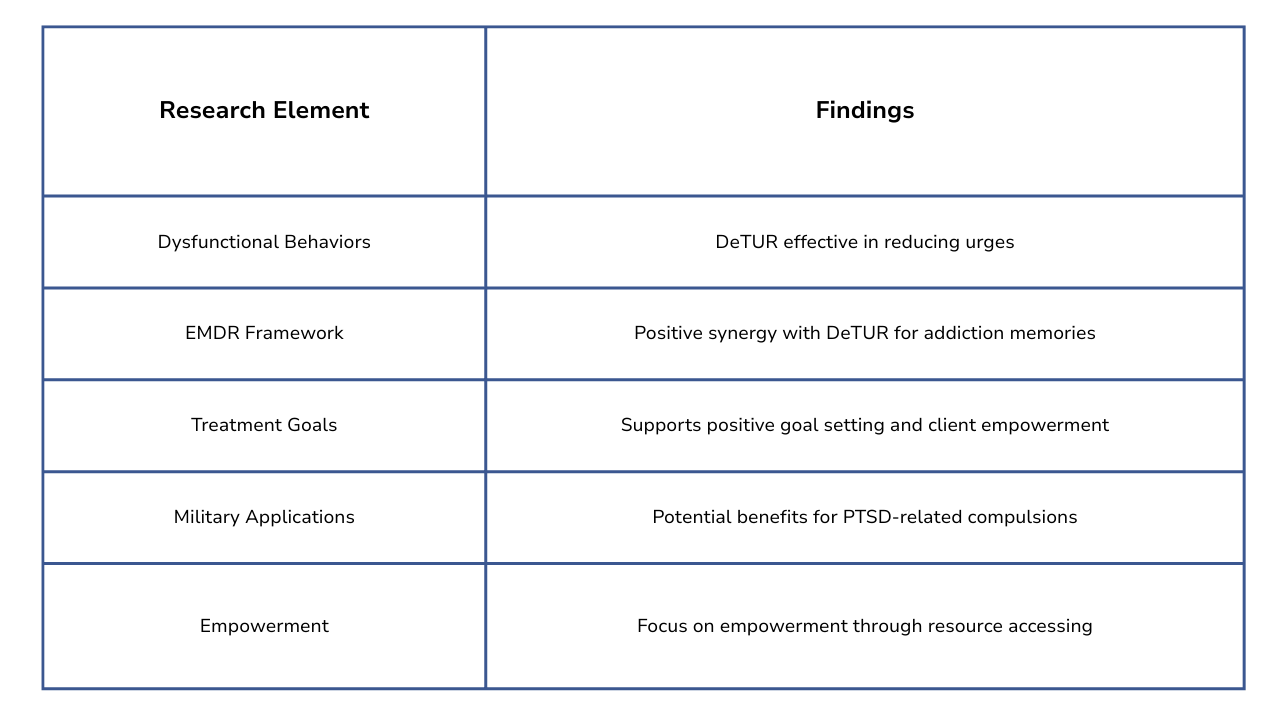
Studies that include Robbie Dunton's applications and those investigating core traumas have bolstered the scientific community’s understanding of EMDR and the specific protocol for addictions like DeTUR. Overall, the emerging empirical research supports the DeTUR protocol as a promising tool in the treatment of addictions and related dysfunctional behaviors. As research continues to validate DeTUR's efficacy, clinicians pursuing advanced trauma therapist training in addiction gain access to the most current evidence-based protocols and implementation strategies.
Comparison with Traditional EMDR Methodologies
The DeTUR Protocol, while rooted in the EMDR framework, charts its own course when contrasted with traditional EMDR techniques. Conventional EMDR is primarily focused on the processing of traumatic memories and experiences. It directs the client to revisit traumatic events in a safe environment to desensitize the distress associated with those memories.
DeTUR, on the other hand, emphasizes the desensitization of triggers and the reprocessing of urges related to dysfunctional behaviors. Unlike regular EMDR, which might broadly target an individual's overall psychological stressors, DeTUR zooms in on the specific urges that lead to substance use or compulsive behaviors. Think of it as a direct line to the heart of the matter, addressing the cravings and impulses head-on.
Importantly, while traditional EMDR can be a lengthy process, DeTUR often aims for quicker urge reduction and client stabilization. This urgency-based approach makes it a distinct arm within the EMDR spectrum, tailoring the therapeutic goals to suit the immediacy of addiction and compulsion-related issues.
Unique Features of the DeTUR Protocol
Switching gears to look closely at DeTUR, let's examine what sets it apart. First off, it incorporates what's known as an 'urge reduction protocol,' applying EMDR's principles directly to reducing the intensity of urges associated with dysfunctional behaviors. But there's more.
- A clear focus on present triggers: DeTUR narrows in on current triggers and the urges they spark, rather than delving primarily into past experiences.
- Client's positive treatment goal: DeTUR integrates a specific positive treatment goal into the therapy process, fostering motivation and a clear direction for the client.
- Use of internal resources: It highlights empowerment through resource accessing, meaning it encourages clients to tap into their own strengths and capabilities as part of the healing process.
These features contribute to an approach that’s not just about coping, but thriving - guiding clients to a place where their own inner resources can be the heroes of their recovery narrative.
Limitations of the Protocol
Like any treatment, DeTur isn't a one-size-fits-all solution. There are a few limitations to bear in mind:
- Applicability: It may not be suitable for all types of addiction; compulsive behaviors rooted in deeper psychiatric issues may require additional interventions.
- Adaptability: DeTUR presumes that the client is already somewhat stabilized; those with acute or severe levels of distress might need more foundational treatments first.
- Research Depth: While promising, research on DeTUR is still developing. More extensive studies are needed to validate its effectiveness across different populations and settings.
Understanding these limitations is crucial for clinicians and clients alike – ensuring expectations align with what the protocol can realistically offer and identifying when an alternative approach may be necessary.
Practical Applications in Addiction Recovery
When it comes to battling addiction and its associated compulsive behaviors, the practical deployment of the DEtur Protocol can be a game-changer for many individuals. This unique approach, rooted in elements of Ericksonian hypnosis and eye movement desensitization, focuses on the desensitization of triggers that often lead to dysfunctional behaviors. The protocol operates on the principle of urge reduction, aiming to help individuals achieve a positive treatment goal rather than merely avoiding negative outcomes.
An integral part of this protocol is its encouragement of client empowerment through resource accessing, arming those in recovery with internal tools to withstand the compulsion to indulge in harmful behaviors. For instance, someone struggling with chemical addictions may use the DEtur Protocol to reduce their cravings significantly, ultimately seeking a fulfilling life devoid of substance dependence.
However, the DEtur Protocol is not a panacea. It's designed to address specific triggers and may require adjunct therapy for other issues like pathological gambling or addresses core issues from core traumas. Success stories are prevalent, with individuals recovering from a wide array of compulsive behaviors, yet the protocol's effectiveness can vary from person to person. For therapists committed to mastering these applications, comprehensive EMDR training for addiction provides the protocol expertise and clinical confidence needed to achieve breakthrough results with clients struggling with compulsive behaviors.
Role of Trained Therapists
The effective implementation of the DeTUR Protocol for addictions or compulsive behaviors hinges largely on the expertise of well-trained therapists. These professionals bring a sophisticated understanding of EMDR protocols and specifically the DeTUR Protocol, which requires specialized knowledge beyond basic EMDR training.
Therapists with advanced EMDR training for addiction are skilled in identifying the addiction memories or underlying traumas that fuel dysfunctional behaviors. They ensure that the process respects the individual's pace, providing a safe therapeutic space for healing. These therapists are equipped to tailor the protocol to address the unique needs of each client, reinforcing positive goals and fostering lasting recovery.
To become proficient in the DeTUR Protocol and other addiction-specific interventions, therapists benefit from rigorous specialized training that includes both theoretical and practical components. Quality addiction training for therapists ensures practitioners can not only apply the protocol effectively but also adapt their approach to the complexity of each individual's situation.
For clinicians seeking to build this expertise, EMDR for the Treatment of Addiction and Compulsions offers comprehensive training in DeTUR and other evidence-based protocols. This specialized training empowers therapists to work confidently with clients struggling with substance use disorders, behavioral addictions, and compulsive behaviors, ultimately improving treatment outcomes and client success rates.
Importance of External Support Systems
Recovery from addiction is rarely a solo journey. While the DEtur Protocol is a formidable tool for urge reduction and empowerment, it thrives with the bolstering of strong external support systems. These systems encompass friends, family, support groups, and sometimes even community resources—all of which can be pivotal in sustaining recovery and preventing relapse.
External supports offer encouragement, accountability, and a sense of connection, all critical factors in maintaining the hard-earned gains from therapy. They provide a safety net, catching individuals if they stumble, and celebrate victories, big and small, on the road to recovery. This communal reinforcement complements the internal resources developed through the DEtur Protocol, creating a comprehensive support network around the individual.
Moreover, these support systems can act as additional motivators, encouraging the continuation of therapy and helping to reinforce the daily use of techniques acquired through treatment. By integrating the external resources alongside the internal ones fostered by the protocol, individuals have a better chance at a successful and sustained recovery.
In summary, the DEtur Protocol serves as one of the promising tools in the kit for the successful treatment of addictions and compulsive behaviors, with trained therapists and robust external support systems augmenting its effectiveness. Each contributes to constructing a resilient recovery framework for individuals dedicated to overcoming their battles with addiction.
Challenges in Implementing the DeTUR Protocol
Implementing the DeTUR protocol, an urge reduction protocol aimed at treating dysfunctional behaviors such as chemical addictions and compulsive behaviors, comes with several challenges:
- Resistance to Change: Clients may exhibit resistance to altering ingrained behavioral patterns, which can be a barrier to the positive treatment goal.
- Complexity of Triggers: Desensitization of triggers involves addressing each trigger comprehensively. This can be daunting since triggers are often numerous and deeply rooted in the client’s experiences.
- Access to Internal Resources: Successful treatment often requires clients to access internal resources, a task that can be difficult for individuals who feel disempowered by their behaviors.
- Training and Expertise: Professionals need specific training, like that provided by EMDR Professional Training and EMDR Solutions, to effectively employ this protocol. Without proper training in Ericksonian hypnosis or understanding of core issues, the protocol's implementation may suffer.
- Client Empowerment: Empowerment through resource accessing is a key aspect of DeTUR. Practitioners must ensure that they foster an environment of client empowerment, which may not always be straightforward.
Professionals like Francine Shapiro, Robin Shapiro, and Marilyn Luber have been influential in the development and dissemination of protocols for addictions, emphasizing the importance of addressing addiction memories, core traumas, and facilitating client empowerment for a more successful treatment.
Recommendations for Further Research
As we strive for successful treatment in the realms of dysfunctional behaviors and addiction memories, the Detur Protocol has emerged as a beacon of hope. Yet, there's still much to explore and understand. Therefore, recommendations for further research are paramount to advancing our knowledge and effectiveness in this domain.
- Efficacy Across Diverse Addictions: Research comparing the Detur Protocol's impact on various chemical addictions versus compulsive behaviors would shed light on its versatility and potential as a universal urge reduction protocol.
- Longitudinal Studies: Longer-term studies to observe sustained client empowerment and the maintenance of positive treatment goals would be beneficial.
- Comparison with Alternative Therapies: Studies comparing Detur with other methods, such as traditional therapies and Ericksonian hypnosis, can offer a richer understanding of where and when it's most effective.
- Desensitization Mechanics: Delving deeper into the desensitization of triggers through Detur could significantly enhance our understanding of the underlying psychological processes.
- Customized Protocols: Investigating how Detur can be tailored to address core traumas and core issues specific to individual histories, such as those found in military bases or among sufferers of post-traumatic stress disorder.
Resources for Addiction Recovery
Addiction recovery is a complex journey, often requiring a tailored approach to address the underlying issues and promote sustainable change. Here's a concise table of resources that can be instrumental in addiction recovery:

Individuals with addiction may benefit from a wide range of treatments, including eye movement desensitization and reprocessing (EMDR), particularly for addiction memories tied to traumatic events. Experts like Francine Shapiro and Robin Shapiro have contributed greatly to this field, while Marilyn Luber and Robbie Dunton continue to extend its applications to contexts such as military bases and those suffering from post-traumatic stress disorder. Accessing appropriate interventions can lead to successful treatment and recovery from a variety of addictions, including chemical addictions and compulsive disorders like pathological gambling.
The Future of EMDR-Based Urge Reduction: Building Your Expertise
As the landscape of addiction therapy evolves, protocols like DeTUR represent a crucial advancement in our understanding and treatment of substance use disorders and compulsive behaviors. The desensitization of triggers and reprocessing of urges offers a targeted, neurobiologically-informed approach that addresses addiction at its roots.
The future of urge reduction strategies looks promising, with continued research validating the efficacy of EMDR-based interventions for addiction. However, the effectiveness of these protocols depends heavily on the skill and training of the clinicians who implement them.
Building Expertise in EMDR for Addiction
For clinicians committed to developing mastery in addiction-focused EMDR work, EMDR for the Treatment of Addiction and Compulsions provides comprehensive trauma therapist training specifically designed for this population.
This on-demand course, led by Gerard Ilaria, LCSW-R (an EMDRIA-certified therapist with 35 years of experience treating addiction and trauma), offers:
- Step-by-step protocol instruction in DeTUR, FSAP, CravEx, and Buzzkill
- Neuroscience foundations grounded in the three-phase addiction model
- Real-world application through case examples and clinical scenarios
- Resourcing strategies for clients with compromised nervous system regulation
- Integration techniques for combining EMDR with 12-step work and other modalities
- 4 EMDRIA-approved continuing education credits
With lifetime access, you can revisit protocols as needed and build the confidence to work effectively with your most challenging addiction cases.
Taking Your Skills to the Next Level
Understanding the theory behind DeTUR is just the beginning. True clinical competency requires:
- Specialized training in addiction-focused EMDR protocols
- Neuroscience literacy around how addiction changes the brain
- Hands-on practice with protocol implementation
- Integration knowledge for combining DeTUR with other interventions
- Clinical confidence in adapting protocols to diverse client presentations
For trauma therapists committed to excellence in addiction treatment, investing in quality EMDR training designed specifically for this population is essential. The right training doesn't just teach protocols. It transforms how you conceptualize and treat addiction, empowering you to achieve breakthrough results with clients who have struggled for years.
Ready to master DeTUR and other evidence-based addiction protocols?
EMDR for the Treatment of Addiction and Compulsions provides the comprehensive, practical training you need to excel in addiction treatment. This on-demand course offers:
- Complete protocol training in DeTUR, FSAP, CravEx, and Buzzkill
- Neuroscience foundations grounded in the three-phase addiction model
- Practical resourcing strategies for dysregulated clients
- Integration techniques for 12-step programs and traditional modalities
- Real-world application through detailed case examples
- 4 EMDRIA, ASWB, and NBCC continuing education credits
- Lifetime access for ongoing skill development
Led by Gerard Ilaria, LCSW-R - an EMDRIA-certified therapist and consultant with 35 years of addiction and trauma treatment experience - this course translates complex neuroscience and protocol theory into actionable interventions that get results in the therapy room.
Explore the course and register here
Your clients struggling with addiction deserve therapists who understand both trauma and the neurobiology of compulsive behavior. This training gives you the expertise to be that therapist, equipped with evidence-based protocols that create lasting change.
The future of urge reduction is here. Build the skills to lead it.
References
Bae, H., Han, C., & Kim, D. (2015). Desensitization of triggers and urge reprocessing for pathological gambling: A case series. Journal of Gambling Studies, 31(1), 331–342. https://doi.org/10.1007/s10899-013-9422-5
Bae, H., & Kim, D. (2012). Desensitization of triggers and urge reprocessing for an adolescent with internet addiction disorder. Journal of EMDR Practice and Research, 6(2), 73–81. https://doi.org/10.1891/1933-3196.6.2.73
Hase, M., Schallmayer, S., & Sack, M. (2008). EMDR reprocessing of the addiction memory: Pretreatment, posttreatment, and 1-month follow-up. Journal of EMDR Practice and Research, 2(3), 170–179. https://doi.org/10.1891/1933-3196.2.3.170
Luber, M. (Ed.). (2009). Eye movement desensitization and reprocessing (EMDR) scripted protocols: Basics and special situations. Springer Publishing Company.
Popky, A. J. (2005). DeTUR, an urge reduction protocol for addictions and dysfunctional behaviors. In R. Shapiro (Ed.), EMDR solutions: Pathways to healing (pp. 167–188). W. W. Norton & Company.
Popky, A. J. (2010). DeTUR (Desensitization of Triggers and Urge Reprocessing): An urge reduction protocol for addictions and dysfunctional behaviors. EMDR Institute.
Shapiro, F. (1989). Efficacy of the eye movement desensitization procedure in the treatment of traumatic memories. Journal of Traumatic Stress, 2(2), 199–223. https://doi.org/10.1002/jts.2490020207
Shapiro, F. (2001). Eye movement desensitization and reprocessing: Basic principles, protocols, and procedures (2nd ed.). Guilford Press.
Shapiro, F. (2014). The role of eye movement desensitization and reprocessing (EMDR) therapy in medicine: Addressing the psychological and physical symptoms stemming from adverse life experiences. The Permanente Journal, 18(1), 71–77. https://doi.org/10.7812/TPP/13-098
Shapiro, R. (Ed.). (2005). EMDR solutions: Pathways to healing. W. W. Norton & Company.
Shapiro, R. (Ed.). (2009). EMDR solutions II: For depression, eating disorders, performance, and more. W. W. Norton & Company.
Young, K. S. (1998). Caught in the net: How to recognize the signs of internet addiction and a winning strategy for recovery. John Wiley & Sons.
Stay connected with fun info, news, promotions and updates!
Join our mailing list to receive the latest news and updates from our team.
Don't worry, your information will not be shared.