

emdr
Professional Development

Stay in the loop
Trauma-informed tools, new trainings, and the occasional pep talk. No spam, ever.


Read Time: 6 minutes
On Veterans Day, the country says thank you. In the therapy room, the more useful question is who is actually sitting across from us, and whether we were trained to see them.
At the end of September, the VA released its 2026 National Veteran Suicide Prevention Annual Report, updated with 2024 data. The headline number is 6,488 veteran suicides in a single year, an average of 17.7 a day. It is the kind of statistic that gets repeated on this day every year and then quietly set aside. For clinicians, though, there's a second number underneath it that changes what the first one means.
In the prior year's report, 61 percent of veterans who died by suicide in 2023 were not receiving VA health care in their last year of life. More than half of the veterans we lose are outside the system built for them. Many of them are in community care, in private practice, in a group practice down the street. Some of them are already on your caseload, and you may not know it.
This post walks through what the newest data says, what it tends to look like in session, where the training gap is, and what to do about it before the next veteran walks through your door.
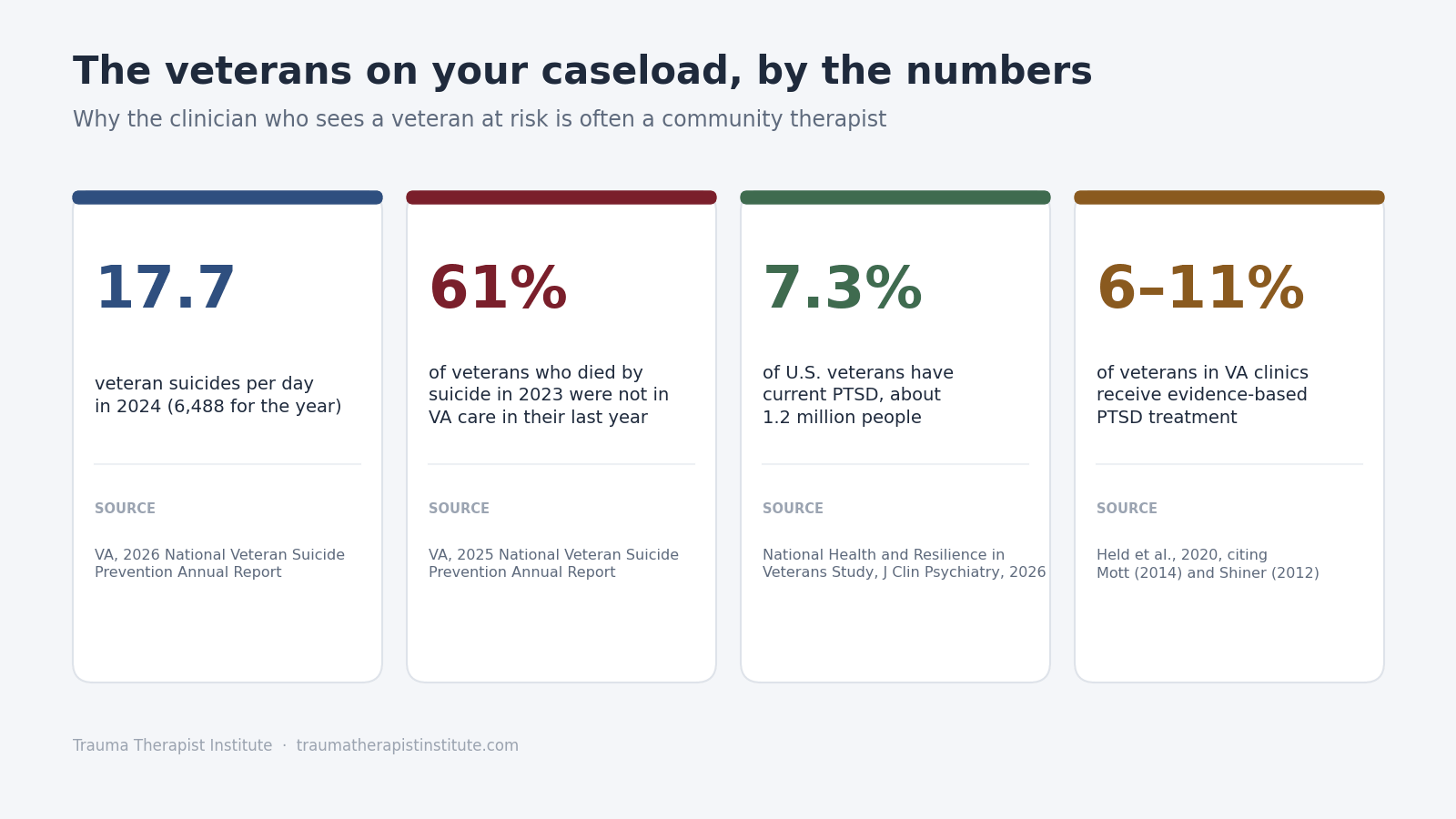
Four numbers that put the clinician in community practice at the center of the picture.
Suicide risk is high and most of it is outside the VA. 17.7 a day is the national rate. The 61 percent figure tells you where. If a veteran at risk is going to be seen by anyone, the odds are good it will be a community clinician who may never have been told the person served.
PTSD is common, and most of it is current. The National Health and Resilience in Veterans Study, published in the Journal of Clinical Psychiatry this year, puts lifetime PTSD at 14.4 percent of U.S. veterans, about 2.5 million people, and current PTSD at 7.3 percent, about 1.2 million. That is a large population, and it rarely arrives labeled. It presents as insomnia, irritability, a marriage under strain, a drinking problem, a job that keeps not working out.
Even inside the system, few get the treatment that works. Research cited in a 2020 feasibility study of intensive PTSD treatment found that only 6 to 11 percent of veterans seen in VA clinics receive evidence-based treatment for PTSD. The gap is not whether trauma-focused therapies work. It is whether the clinician in the room was trained to deliver them, and trained to recognize when a veteran needs them.
Community providers mostly aren't ready. When RAND assessed New York's civilian health workforce, only 2.3 percent of providers fully met the criteria for delivering culturally competent care to veterans. Only one in five screened patients for military service at all, and two-thirds reported being unfamiliar with military culture. New York is not unusual. Most graduate programs cover trauma broadly and military culture barely at all.
The data describes a population. These are the moments where it shows up in the room.
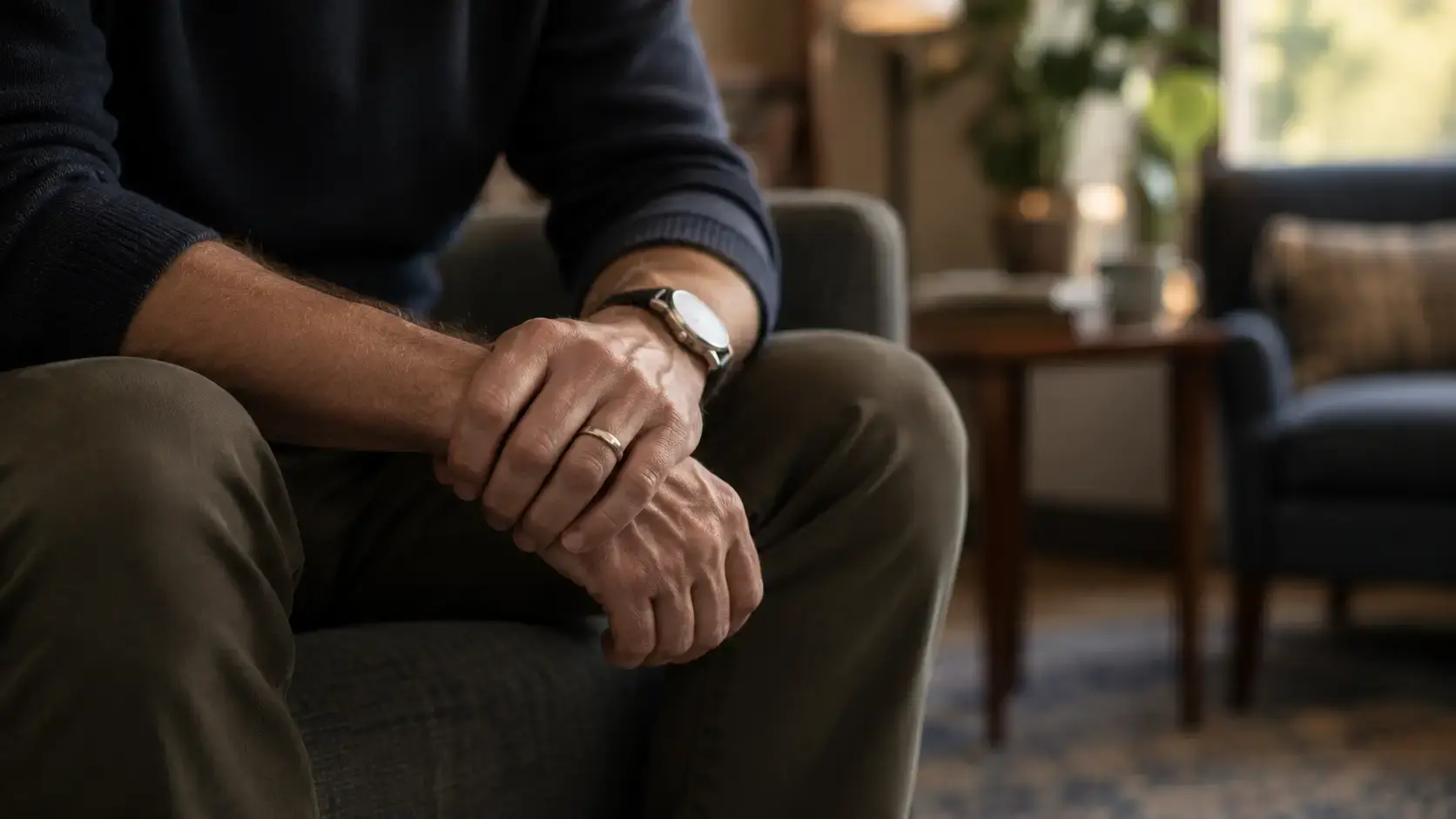
Curated answers. A client who says they're fine, means it as a complete sentence, and ten minutes later jokes about not making it to fifty. The joke is doing work. In military culture, humor is often the sanctioned channel for things that cannot be said directly, and an untrained clinician will laugh along and move on.
Slow trust. Service members are taught to assess whether the person in front of them can handle what they carry. A civilian clinician who hasn't earned that assessment will get a polished, cooperative, surface-level client for weeks. This is not resistance. It's a screening process, and knowing that changes how you run the first three sessions.
Hidden risk. The highest-risk veteran in your practice may be the one who shows up on time, holds a job, and has a plan for everything. Stoicism and high functioning are not protective factors in this population; they are often the presentation that risk hides inside. Standard screening questions, asked the standard way, will not reach it.
Moral injury cues. Shame, guilt, and a sense of having betrayed or been betrayed by one's own values are distinct from PTSD and often precede a crisis. They don't respond to fear-based trauma protocols, and a clinician who treats moral injury as PTSD can leave the client feeling more alone than before. Dr. Arielle Jordan's post on moral injury in military clients goes deeper on recognition and treatment.
For a fuller picture of the cultural blind spots, read Dr. Jordan's What Civilian Therapists Miss About Military Clients. This post builds on it with the newest data rather than repeating it.
Most clinicians were never trained for this population. That's not a criticism; it's a curriculum fact. Graduate programs teach trauma as a general category. They rarely teach military culture, the neurobiology of operational stress, how reintegration strains a family system, or why PTSD in veterans so often travels with depression, substance use, and chronic pain. So skilled clinicians improvise: a workshop here, a webinar there, a lot of good instinct and a persistent sense that something in the room is being missed.
The veterans in community care deserve better than improvisation, and the data says community care is where many of them are.
If you or a veteran you work with is in crisis, the Veterans Crisis Line is available 24/7: dial 988 and press 1, or text 838255.
Griffin, B. J., Purcell, N., Burkman, K., Litz, B. T., Bryan, C. J., Schmitz, M., Villierme, C., Walsh, J., & Maguen, S. (2019). Moral injury: An integrative review. Journal of Traumatic Stress, 32(3), 350–362. https://doi.org/10.1002/jts.22362
Held, P., Klassen, B. J., Boley, R. A., Wiltsey Stirman, S., Smith, D. L., Brennan, M. B., Van Horn, R., Pollack, M. H., Karnik, N. S., & Zalta, A. K. (2020). Feasibility of a 3-week intensive treatment program for service members and veterans with PTSD. Psychological Trauma: Theory, Research, Practice, and Policy, 12(4), 422–430. https://pmc.ncbi.nlm.nih.gov/articles/PMC6980160/
New York State Health Foundation. (2018). Ready or not? Assessing the capacity of New York State health care providers to meet the needs of veterans (RAND Corporation study summary). https://nyhealthfoundation.org/?p=18142
Pietrzak, R. H., et al. (2026). National trends in PTSD among U.S. veterans: Results from the National Health and Resilience in Veterans Study. Journal of Clinical Psychiatry. https://www.psychiatrist.com/jcp/national-trends-ptsd-us-veterans-2025-2026-national-health-resilience-veterans-study/insights/
U.S. Department of Veterans Affairs. (2025). 2025 National Veteran Suicide Prevention Annual Report (2023 data) [Press release]. https://news.va.gov/press-room/va-releases-annual-veteran-suicide-prevention-report-updated-with-2023-data/
U.S. Department of Veterans Affairs. (2026, September 30). 2026 National Veteran Suicide Prevention Annual Report (2024 data) [Press release]. https://news.va.gov/press-room/va-releases-annual-veteran-suicide-prevention-report-updated-with-2024-data/