
emdr
parts work
EMDR Mastermind Series

Stay in the loop
Trauma-informed tools, new trainings, and the occasional pep talk. No spam, ever.


Read Time: 12 minutes
There is a particular kind of client who appears on most experienced EMDR caseloads, often after several years of practice, and who introduces a question the training literature rarely addresses with precision. This client has been doing well for some time. They have not experienced a meaningful flooding response in months, the original target memories that brought them into treatment have grown quiet, their PCL-5 score has come down significantly, and they continue to attend sessions consistently while making use of the regulation tools they developed earlier in the work. They are functioning well at work, in relationships, and in the parts of their life that previously felt unreachable. And yet, despite all of these markers, they continue to come, week after week, and the sessions have gradually shifted into something that resembles supportive psychotherapy more than active trauma work.
The clinical instinct in these moments tends to be clear, even when the path forward feels less so. Something in your case conceptualization suggests that the EMDR portion of the work has effectively reached its conclusion, though you find yourself unable to identify the precise moment to articulate this to the client. The result is that treatment often continues for months, sometimes for years, longer than its underlying clinical purpose required. This represents one of the more common and least openly discussed challenges in post-basic-training EMDR practice. Graduation receives surprisingly little structured attention in most training programs, which has produced a field of experienced clinicians who possess a more developed framework for selecting target memories than for recognizing when those targets have stopped requiring selection.
Basic EMDR training devotes substantial time to the eight-phase model, though the published protocol literature has traditionally treated graduation as an extension of Phase 8 rather than as a clinical determination in its own right (Shapiro, 2018). Phase 8 covers reevaluation, which involves checking in on previous targets, assessing whether earlier work has held, and identifying remaining material. What this phase does not provide, in any structured way, is guidance on what graduation actually looks like or how to recognize that a client has arrived there.
This gap is partly a function of the field's history. EMDR was developed and codified during a period when most psychotherapy outcome research framed treatment endings around symptom remission rather than around the structural integration of memory networks. The protocol inherited that framing, and most EMDR clinicians inherited the protocol along with its assumptions. The practical consequence has been a tendency to default to general psychotherapy termination frameworks, including the gradual reduction in session frequency, the processing of the therapeutic relationship, and the planning for life beyond therapy, without developing a parallel framework specific to the AIP-informed work being concluded.
This matters because the work itself is structurally different from the general psychotherapy that informs most termination frameworks. EMDR is goal-directed in ways that most modalities are not. The target memories were specific, the treatment plan defined particular clinical outcomes, and the standardized assessments at intake provided baseline data against which subsequent work could be measured. All of that infrastructure makes EMDR graduation potentially more measurable than termination in many other modalities, though the field has not always made full clinical use of what is available.
The clinicians who manage to graduate clients well from EMDR tend to share three consistent practices. They define what graduation looks like at the start of treatment rather than at the end. They draw on both objective outcome data and structured clinical observation to evaluate readiness as the work progresses. And they treat graduation as a collaborative clinical decision the client participates in actively, rather than as something the therapist determines and then announces.
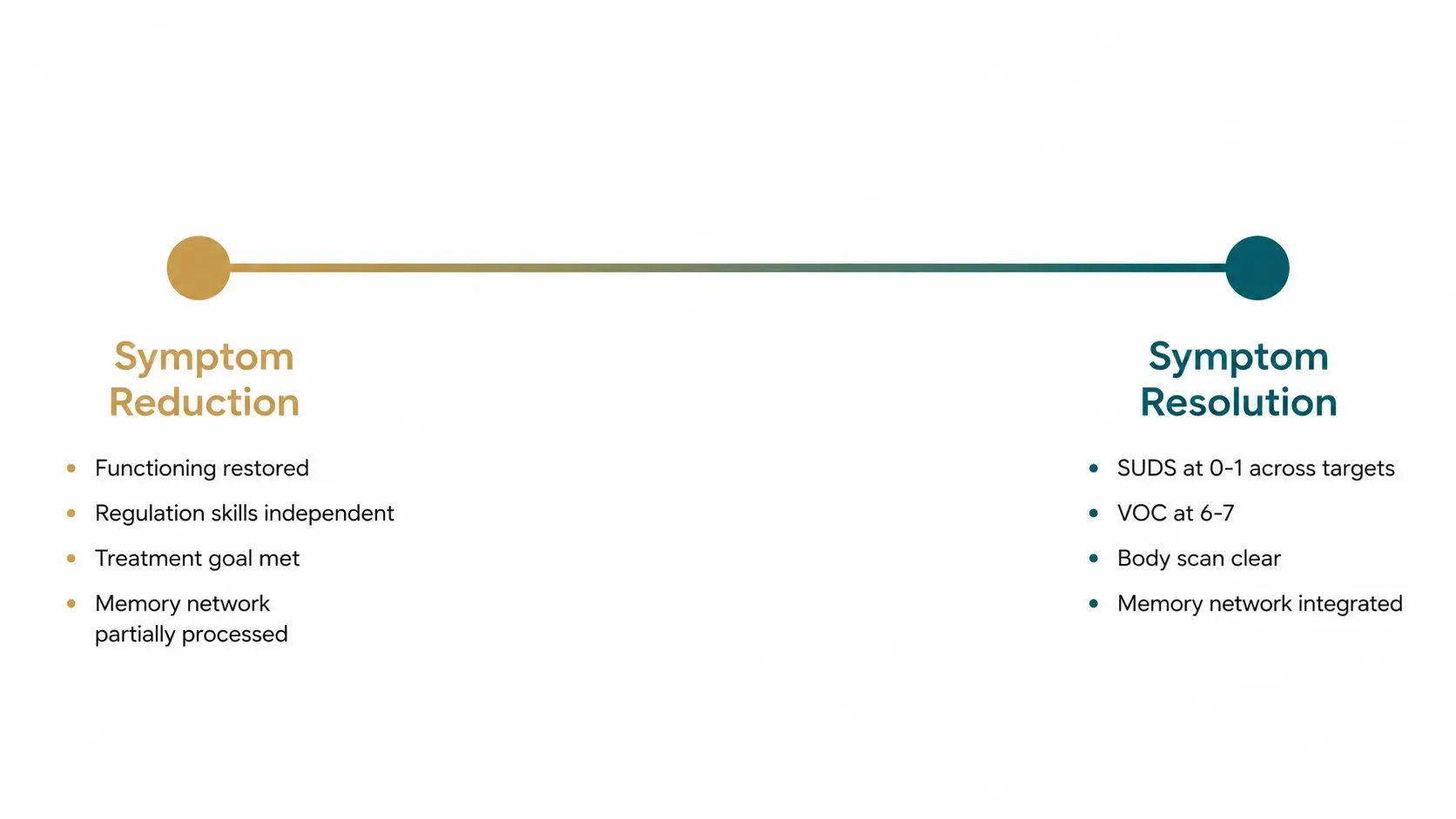
Graduation looks substantively different depending on the treatment goal you and your client agreed on at the beginning of the work. As I explored in the previous piece on EMD, EMDr, and full EMDR, symptom reduction and symptom resolution represent meaningfully different clinical endpoints, and that distinction tends to shape the entire arc of treatment.
For clients whose treatment goal was symptom reduction, graduation looks like measurable improvement in the symptoms that brought them into treatment, accompanied by sufficient regulation capacity to engage with the parts of life that were previously impaired, all held together by skills the client can use independently between and beyond sessions. The client may not be entirely free of trauma symptoms in this scenario, and the absence of complete symptomatic clearance does not represent a clinical failure. They are functioning well within the conditions their nervous system can sustainably hold, and they possess the resources to continue doing so. Many clients with chronic complex trauma will graduate from EMDR at this endpoint, and that graduation carries clinical meaning even though portions of the memory network may remain unprocessed.
For clients whose treatment goal was symptom resolution, the markers of graduation involve more substantial integration. The target memories should be processed to a SUDS of zero or one, with the positive cognition installed at a VOC of six or seven. The body scan should remain clear when the client returns to those original targets, and future template work should have been completed for anticipated triggers, with that work feeling solid rather than rehearsed.
Reaching those markers sometimes depends on work done much earlier in treatment, at the points where a target stalled and needed a well-matched interweave to move again. Choosing the right interweave for a blocked target can be the difference between a target that merely quieted and one that fully resolved.
A question that surfaces regularly in post-basic-training consultation deserves direct attention here. If a client reports feeling significantly better and their assessment scores have improved substantially, but you have not processed every memory in the network you originally mapped during Phase 1, has treatment reached its conclusion? The answer depends substantially on what you contracted for at the outset. If the agreement was symptom reduction and the client has achieved the level of functioning they came in seeking, treatment has likely arrived at its endpoint. If the agreement was symptom resolution and the network has not been fully integrated, the work likely continues, even when the client subjectively feels much better in the present. Feeling better and being structurally integrated represent related but distinguishable clinical realities, and the original treatment plan is the document that clarifies which standard applies in a given case.
This is also where revisiting the treatment contract throughout the work becomes important. Clients who began treatment seeking symptom reduction sometimes discover, midway through the work, that they want symptom resolution after all. The reverse can also occur, particularly when the demands of resolution become clearer than they were at intake. Renegotiating the goal explicitly with the client, as a deliberate clinical conversation, is part of mature treatment planning. Graduation is properly anchored to whatever goal is current rather than to whatever was originally documented.
Standardized outcome measures remain among the most underused tools in many EMDR clinicians' practices. The measures are administered at intake, often because insurance or licensing standards require it, and then frequently sit in the clinical record untouched for the duration of the work. This represents a meaningful missed opportunity. Re-administering the PCL-5, GAD-7, PHQ-9, and DES-II at structured intervals throughout treatment provides objective data about whether the work is moving and helps establish where the client sits in relation to the graduation endpoint defined at the start.
The broader literature on psychotherapy outcome measurement offers a useful framework for thinking about this data clinically. Jacobson and Truax (1991) introduced the concepts of reliable change and clinically significant change, which together provide a more rigorous way to evaluate treatment progress than the simple before-and-after comparison most clinicians intuitively rely on. Reliable change asks whether the magnitude of change on a given measure exceeds what could plausibly be attributed to measurement error alone. Clinically significant change asks whether the client has moved from the dysfunctional range of the relevant population into the functional range. Both criteria can be calculated for individual clients using published norms for most validated instruments, and Lambert and Ogles (2009) provide a useful overview of how these calculations apply in practice, including their recommendations for adopting Jacobson's framework as a standard across psychotherapy outcome research.
In practical application, this means clinicians have access to a data-informed answer to the question of whether their EMDR work has produced real and sustained change. A client whose PCL-5 score has dropped from fifty-five at intake to twenty-five after twenty sessions has achieved both reliable change, in that the magnitude of change exceeds measurement error, and meaningful movement toward the functional range of the population. A client whose score has dropped from fifty-five to fifty has not yet achieved either marker in any clinically meaningful sense. The graduation conversation looks quite different in each of these scenarios, and the data provides language for what would otherwise be a more intuitive determination.
There is also a subtler use of outcome data that warrants mention. Patterns of change across multiple measures often communicate something useful about the structure of what is shifting during treatment. A client whose PCL-5 score has resolved while their PHQ-9 score has barely moved is telling you something quite different than a client whose PCL-5 and PHQ-9 have moved together. The first client may have processed their core trauma but be left with a depressive presentation that requires different clinical work. The second client has likely undergone broader nervous system integration. Either pattern carries clinical meaning, and either may shape what graduation looks like in that particular case.
Outcome data, however carefully gathered, does not provide the whole clinical picture. It functions as one essential input among several. Clinicians who rely only on assessment scores tend to miss the clinical information that does not appear on a measure, while clinicians who rely only on clinical observation tend to miss the rigor that objective measurement provides. The most defensible graduation decisions emerge when both inputs converge meaningfully.
Some of the most important indicators of graduation readiness do not appear on standardized measures. They show up in the texture of the work itself, in the way the nervous system responds to old material, and in how the client moves through their life during the time between sessions.
One of the clearest signs involves what happens when the client returns to old target memories during reevaluation. Memories that were once heavily charged become unremarkable to the client. They can recall the events, often with the same accuracy as before, but the recall no longer carries the same affective load. The body scan remains clear. The negative cognition that previously felt true to them sounds, in their own report, like something that someone else used to believe rather than something they are still working through. This represents what AIP-informed integration looks like in practice. The memory has been moved into adaptive networks and is now stored differently, and it no longer drives the symptoms that originally brought the client into treatment.
A second sign appears in the client's response to present-day triggers connected to old material. Triggers that previously sent them into hyperarousal or shutdown now produce a brief, manageable activation that resolves on its own without significant clinical intervention. They notice the trigger, often name it accurately, sometimes use a regulation skill, and return to baseline within minutes rather than hours or days. This kind of in-vivo evidence is often more clinically persuasive than any single assessment score because it tells you the work has generalized into the conditions of actual life.
A third sign is functional in nature. Work, parenting, intimate relationships, friendships, the parts of life that previously felt either inaccessible or actively contaminated by the trauma, have become available again to the client in meaningful ways. The client is not simply experiencing symptoms less frequently. They are engaged in activities and relationships they could not access before treatment began. This represents the kind of change that tends to matter most to clients themselves, and it is often the change they cite, late in treatment, when asked what has been most useful about the work.
A fourth sign, easy to miss in the structure of session-by-session work, involves what the client does during the time between sessions. They may have internalized the work to the point where they can engage in regulatory work on their own behalf. They may be using future templates without being prompted by the therapist. They may catch themselves heading toward an old pattern and adjust course before the pattern fully establishes itself. When clients begin to function as their own EMDR therapist between sessions, in this sense, treatment is often approaching its appropriate conclusion.
When both the outcome data and the clinical picture support graduation, the next step involves the conversation itself. This conversation functions as a clinical intervention in its own right, and how it is conducted tends to shape how the work integrates after therapy formally ends.

It is often useful to begin by reviewing the original treatment goals together with the client. Most clients have lost track of where they started by the time they approach graduation, and this is particularly true of clients who have been in treatment for longer periods. Returning to the long-term objective defined at Phase 1 and comparing it explicitly to where the client now sits often produces a powerful moment for both clinician and client. This externalizes the progress and makes the graduation decision visible rather than implicit.
It also helps to distinguish graduation from termination of the therapeutic relationship itself. EMDR graduation indicates that the active trauma work has reached its endpoint. It does not necessarily mean the client will never see the therapist again. Some clients want a clean ending, with no further contact planned. Others prefer maintenance sessions at quarterly or biannual intervals, an option that often makes particular sense for clients with complex trauma whose nervous systems benefit from periodic check-ins as their life circumstances continue to evolve. Both options carry clinical legitimacy, and the conversation should make space for the client to choose meaningfully between them.
The ambivalence that often accompanies this conversation deserves direct clinical attention. Some clients will be ready to graduate before they feel ready, in the sense that the data and observable progress support graduation while the client experiences the prospect of ending as a kind of loss. This experience is particularly common with clients who have been attending weekly sessions for two or three years, and the loss they experience is not necessarily clinical regression. It often reflects the genuine significance of the therapeutic relationship in their recovery. Naming this dynamic openly, normalizing it, and processing it as part of the closing work is what tends to make the ending therapeutic rather than abrupt. Conversely, some clients will believe they need ongoing therapy long after the EMDR work has genuinely concluded. The clinician's role in these cases involves helping the client see both the objective data and the clinical picture, supporting their autonomy in making the decision, and respecting their own evaluation that the work has reached its appropriate endpoint.
Planning carefully for what comes after graduation matters considerably. An ending that integrates well includes a clear plan for what the client will do if symptoms return, what triggers may be reasonably predictable in the next year of their life, and what their early relapse signals tend to look like. A future template revisit, sometimes brief, often makes sense as a closing intervention. The aim is to send the client into life beyond therapy with the resources they need rather than with an unsupported sense of being on their own.
The more straightforward graduation decisions occur when outcome data and clinical observation point in the same direction. The clinically more difficult cases involve the ones where they diverge meaningfully.
Sometimes the assessment scores have improved substantially while you retain a clinical sense that something remains unresolved. The client may continue using certain coping strategies that suggest unprocessed material lingering beneath the surface. A particular topic may be consistently avoided in session despite apparent progress elsewhere. Their reports of progress may feel more performative than embodied to you. In these cases, the clinical instinct represents real information that warrants further investigation before graduation. The instinct does not override the data, though it is worth taking seriously as a clinical signal. A few additional sessions focused specifically on what feels unresolved often clarify the picture meaningfully. Sometimes new material emerges that extends the treatment plan, and sometimes the clinician's instinct reveals itself as transference reaction or as the therapist's own discomfort with the ending. Either way, the investigation itself represents responsible clinical practice.
The opposite picture also occurs with some regularity, and it tends to receive less attention in the literature. The assessment scores have not budged much, while the client reports feeling significantly better and is observably functioning well in their life. This pattern appears more frequently than published research suggests, particularly in clients with complex trauma whose baseline scores were extreme and whose subjective experience of recovery has outpaced their psychometric scores. In these cases, it tends to be useful to look closely at functional indicators that operate outside the formal measures. Is the client working in ways they could not before? Sleeping adequately? Engaged in relationships that function reasonably well? When the lived life has shifted substantially even as the numbers have not, that itself is meaningful clinical data. Sometimes the appropriate response is graduation with planned check-ins, and sometimes it is continued work focused specifically on the symptoms the measures are still capturing.
The underlying principle in both scenarios remains consistent. Graduation is a clinical decision that integrates objective data, structured clinical observation, and the client's own report of their experience. None of these three inputs proves sufficient in isolation. The clinician's task involves weighing all three and arriving at a defensible decision that honors what each input is communicating.
The clinicians who manage EMDR graduation well tend to share a particular practice. They build graduation into the treatment plan from the very beginning of the work. They define what success will look like before reprocessing has even started, drawing on the kind of evidence-based outcome measures referenced in EMDRIA's research overview. They use standardized measures consistently throughout treatment rather than only at intake. They treat the treatment plan as a living document, revisited at structured intervals, with the long-term objective remaining in view throughout the work. By the time graduation arrives, it does not surprise either the therapist or the client. It represents the destination both parties have been deliberately moving toward all along.
Graduation in EMDR deserves the same kind of clinical rigor we bring to case conceptualization, target sequencing, and protocol selection. It is part of the work rather than separate from it, the moment when the treatment plan has fulfilled its purpose and the client is positioned to carry forward what they built during the course of therapy.
|
Want a clearer framework for organizing your EMDR work from intake through graduation?
Our EMDR Treatment Planning Training with Dana Carretta-Stein, LMHC, LPC, EMDRIA Approved Consultant, walks you through the full clinical framework for case conceptualization, target sequencing, treatment plan reviews, and graduation criteria. Two CEs. Live July 24, 2026, with replay available. |
EMDR International Association. (n.d.). Recent research about EMDR. https://www.emdria.org/about-emdr-therapy/recent-research-about-emdr/
Jacobson, N. S., & Truax, P. (1991). Clinical significance: A statistical approach to defining meaningful change in psychotherapy research. Journal of Consulting and Clinical Psychology, 59(1), 12–19. https://doi.org/10.1037/0022-006X.59.1.12
Lambert, M. J., & Ogles, B. M. (2009). Using clinical significance in psychotherapy outcome research: The need for a common procedure and validity data. Psychotherapy Research, 19(4-5), 493–501. https://doi.org/10.1080/10503300902849483
Shapiro, F. (2018). Eye movement desensitization and reprocessing (EMDR) therapy: Basic principles, protocols, and procedures (3rd ed.). Guilford Press.
Weathers, F. W., Litz, B. T., Keane, T. M., Palmieri, P. A., Marx, B. P., & Schnurr, P. P. (2013). The PTSD Checklist for DSM-5 (PCL-5). National Center for PTSD. https://www.ptsd.va.gov/professional/assessment/adult-sr/ptsd-checklist.asp